
Two Countries, One Disease
How Trump and Netanyahu - the democratic world's current champions of right-wing authoritarian populism - perfected contempt for the public they claim to represent

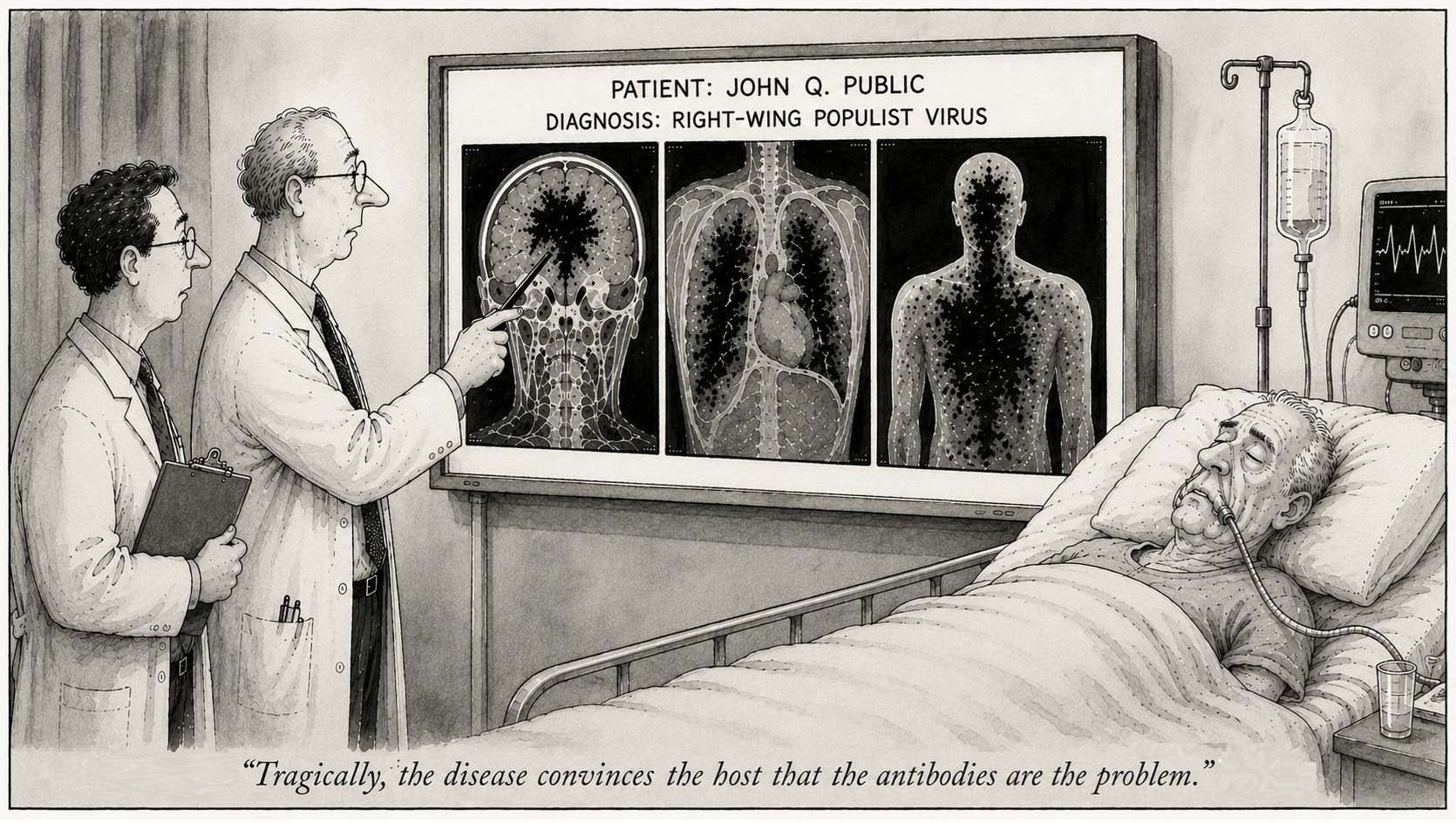
Right-wing populism always claims to speak for “the people.” But its deepest instinct is usually contempt for the people — and for the idea that ordinary citizens deserve institutions that are honest, competent, independent, and governed by rules rather than loyalty to some megalomaniac. Its leaders present themselves as tribunes of democracy while destroying it. Expertise becomes suspect. Professionalism becomes weakness. Criticism becomes treachery. And institutions exist to protect not the public but the ruler. The whole catastrophe.
Consider upgrading to a Paid Subscription to unlock access to all content including the Critical Conditions podcast - and also enable us to hire a real cartoonist
Two episodes this past week illustrated that pathology with unusual clarity. One unfolded in the United States, the other in Israel — two countries that not only suffer acutely from this disease, but are also heading toward perhaps the two most consequential elections in the democratic world this fall. In Washington, Donald Trump’s appointment of Bill Pulte as acting Director of National Intelligence was another insult directed at the American people. In Jerusalem, Benjamin Netanyahu’s coalition descended into near-banana-republic tactics to appoint a state comptroller who would be a puppet of the prime minister — another insult at the Israeli people. Different countries, different systems, same decay: the substitution of loyalty for legitimacy, and power for principle. The twin disgraces are not only linked but farcical each in its own way. Let’s dive in!
The Pulte appointment is one of those moments that crystallizes the whole absurdity of the era into a single act — the kind that makes people who still care about governing competence want to throw up their hands and spend a year hiding on a desert island.
Not because most Americans spend their days thinking about the Director of National Intelligence. Most could not explain the difference between the CIA and the NSA, much less the role of the Director of National Intelligence, or DNI. But some positions in government are supposed to sit outside the circus. They are supposed to be serious offices entrusted to serious people because the stakes are too high for amateurism.
The office of the Director of National Intelligence was born from the catastrophic intelligence failures surrounding September 11, 2001. After the attacks, investigators concluded that America’s sprawling intelligence apparatus had become dangerously fragmented. Agencies hoarded information. Amid rivalries and bureaucratic silos, no one owned the bottom line.
Congress responded by creating the DNI in 2005: a coordinating figure intended to sit above the agencies and integrate the work of America’s 18 intelligence bodies. The DNI became the president’s top intelligence adviser, overseer of the National Intelligence Program budget, and the official responsible for ensuring that intelligence was evaluated coherently rather than politically.
This extremely serious position helps determine what information reaches the president, what threats are emphasized, and how competing assessments are adjudicated. China, Russia, Iran, cyberwarfare, terrorism — the DNI sits at the nerve center of how the United States understands the world.
Historically, the people entrusted with this responsibility reflected the gravity of the task. John Negroponte, the first DNI, was a veteran diplomat and national-security operator. Mike McConnell was a retired admiral and former NSA chief. James Clapper spent decades inside military and intelligence institutions. Avril Haines emerged from the CIA and National Security Council world. Even controversial or politically aligned appointees like Richard Grenell or the more recent Tulsi Gabbard arrived with at least some foreign-policy, military, diplomatic, prosecutorial, or congressional national-security experience.
The 38-year-old Pulte, the head of the Federal Housing Finance Agency, does not. His background lies in real estate, housing finance, and the swamp of MAGA politics. He is the grandson of the founder of PulteGroup and built his public persona through viral online giveaways and aggressive social-media engagement. During the Trump era, he became increasingly aligned with the MAGA movement and emerged as a highly visible Trump loyalist.
There is nothing inherently dishonorable about business experience. Nor is outsider status automatically disqualifying. Even MAGA affiliation — though this one is a close call — should not disqualify. But intelligence leadership is not a generic managerial assignment. It requires deep familiarity with how intelligence is collected, vetted, challenged, and protected. It requires understanding the culture of the intelligence agencies, the dangers of politicized analysis, and the catastrophic consequences of getting things wrong. It requires credibility.
People inside the CIA, NSA, Defense Intelligence Agency, and broader national-security bureaucracy must believe the person at the top understands the craft. They must believe intelligence judgments will be weighed on merit rather than ideological usefulness. The system depends on professionals feeling safe to present uncomfortable truths to power. (So that, say, if there are no weapons of mass destruction, we don’t invade on that pretext).
The appointment of Pulte, who utterly lacks qualifications to such a role, is nothing short of a scandal. It tells Americans that their security counts for nothing. And it redefines the role, contrary to the intention of Congress, from a major security responsibility to another political lickspittle.
Moreover, by making him the “acting” director Trump can circumvent Congress, a tactic he has used before. He can be counted on to try to drag out the interim phase and make it effectively permanent, until Congress rebels — and the Republicans’ track record on this is horrendous. The rules are not always clear.
For years, Trump’s defenders have argued that critics exaggerate. They insist that every president rewards allies, distrusts hostile bureaucracies, and seeks ideological alignment within government. There is truth in that. Franklin Roosevelt, John Kennedy, George W. Bush — all presidents valued loyalty. But no one in recent history did this. Indeed, in my years of foreign correspondence, I haven’t see it in a functioning democracy.
This is, obviously, not happening in isolation.
This same week, the administration was forced into a humiliating retreat over its astonishing proposal for a $1.8 billion “Anti-Weaponization Fund” — a mechanism critics across the political spectrum viewed as a potential patronage scheme for Trump allies and January 6 defendants. Even Republican senators recoiled — which felt like seeing pigs fly. The plan became politically radioactive so quickly that Acting Attorney General Todd Blanche (yup, another lickspittle who is “acting” like someone reasonable) publicly abandoned it before Congress after bipartisan outrage and judicial scrutiny mounted. It was an obvious grift.
Are there finally signs that parts of the system are beginning to resist?? For years, Trumpism has operated on the assumption that institutional actors would eventually submit — that Republicans, courts, donors, media companies, and corporate elites would grumble privately while yielding publicly. That assumption proved correct. But lately the cracks have widened. Even sections of conservative media are beginning to hint that this cannot continue indefinitely. My assessment is it will, until the Democrats regain power, on the Hill or in the White House. A colossal housecleaning will eventually arrive — perhaps if the Republicans lose the midterms badly, as they richly (and urgently) deserve.
As extraordinary as it sounds, Israel produced its own version of the same phenomenon this very week, and it was possibly even worse. I know that is literally incredible. Read on.
To outsiders, the intensity of feeling around Netanyahu can sometimes seem bewildering. Here is a politician of extraordinary skill: disciplined, articulate, historically consequential, electorally resilient, deeply fluent in the language of geopolitics and power. Many abroad see a polished leader who has navigated Israel through wars, technological transformation, regional realignment, and international isolation. A figure who dominates the political arena with unmatched instinct and stamina.
So they often struggle to understand why so many Israelis react to him not merely with opposition, but with exhaustion, fury, and moral revulsion.
The reasons are numerous and cumulative: the corruption trials, the effort to Putinize the country and destroy state institutions, the permanent manipulation, the serial falsehoods, the failed strategic assumptions about Hamas, the relentless cultivation of tribal resentment, the vulgar politics of personal loyalty, the exhausting expense scandals, the transformation of every disagreement into an existential struggle between patriots and traitors. Explaining the full picture is a unappealingly Herculean task even for people who are interested in corruption.
So it can be useful when there arrives a clarifying moment — a small episode that crystallizes the broader pathology more clearly than any grand speech or ideological argument ever could. Israel had such a moment this week on the occasion of the Knesset vote for state comptroller, one of the most sensitive institutional positions in Israeli public life. The main task is basically to ‘comptrol” the prime minister’s office.
The comptroller is elected by secret ballot among all 120 members of parliament. The office audits government ministries, investigates failures of governance, oversees public integrity, and possesses enormous influence over public accountability. In the aftermath of October 7 and the Gaza war, the role carries even greater significance. The comptroller may shape future investigations into catastrophic national failures and wartime decision-making.
Historically, the office has usually gone to senior judges, jurists, or respected public servants with reputations for independence. Figures such as Miriam Ben-Porat, Eliezer Goldberg, and Micha Lindenstrauss embodied a certain ethos: stern institutional guardians standing somewhat above partisan warfare. So naturally, Netanyahu nominated his longtime personal lawyer, Michael Rabello, for the role.
You see the little trick? If appointed, he would be in a conflict of interest vis-a-vis his main subject of oversight, being forced to recuse himself from anything involving Netanyahu, which could be defined broadly enough to attack to the whole Cabinet. It is a middle finger the size of Mt. Rushmore.
Yet an even more astonishing aspect came during the voting itself, in which the opposition candidate was a completely qualified and serious former Supreme Court justice. Netanyahu’s coalition has vilified the Supreme Court, and ministers have even suggested — in an Israeli first — they do not feel they must obey it. The first round reportedly revealed several coalition defections. Netanyahu’s puppet stumbled and a second ballot was needed. The coalition — an assemblage of hacks, ex-cons and mediocrities — was in panic.
Suddenly, allegations and reports emerged that lawmakers were being asked to photograph or film their ballots in order to prove loyalty.
Pause for a moment and consider the meaning of that. Secret ballots exist precisely because democracies understand that free voting collapses when superiors can verify obedience. The entire purpose of ballot secrecy is to protect individuals from coercion, intimidation, retaliation, and patronage systems. Modern democracies adopted secret ballots in the nineteenth century to break the power of bosses, landlords, oligarchs, and political machines.
There was a pause in the proceedings as the Knesset speaker, Likud’s Amir Ohana, received legal advice to not allow phones in the voting area. He ignored it and restarted the vote anyway. Israel media filled with coalition lawmakers posting images of themselves voting the right way. The images and reports were the excruciating stuff of banana republics, utterly unprecedented in Israel.
Indeed, I cannot recall another scene quite like it in a functioning democracy. A little like the various freak shows happening right now in the United States.
Opposition leaders planned to appeal to the Supreme Court, calling the vote “tainted.” My guess is that they will find no illegality — only stench. The judges are human, and they too are tired of fighting (and facing Netanyahu mobs outside their homes) — and they’re just trying to wait out the nightmare. Like in America.
The episode illustrated perfectly the culture Netanyahu has spent years cultivating. We have here a prime minister facing trial for bribery and fraud ramming his own lawyer into the top civil service oversight role — precisely because conflict-of-interest disqualifies him. How can he not be ashamed? Because there is no more shame.
This episode offers you on a platter the whole story compressed into a single degrading scene. It feels unclean to even describe it any further.
It is amusing (you take your entertainment where you can find it) that this comes the same week we Trump and Netanyahu had a huge spat — or rather, that Trump leaked that they did in order to humiliate Netanyahu. The origin of this, in a way, is a March 2 statement by Marco Rubio in which he dopily suggested the US was dragged into the Iran war by Israel (Israel was going to attack anyway, err, and then Iran would have attacked us), thus making Trump look like Netanyahu’s chump, even more than usual. Payback was only a matter of time.
That time was this week, and the context is that (as we explored last week) Trump is flailing because the US had no plan for Iran, however thrashed, blocking the Strait of Hormuz and freaking out the global economy. Desperate for an exit ramp in which Iran will give him something, anything, on the nuclear issue, Trump ordered Netanyahu to cease (justifiably) bombing Hezbollah in Lebanon, as Iran demands. In a call he called Netanyahu “fucking crazy” and told him everyone now hates him, and Israel too, and that if it wasn’t for Trump, he, Netanyahu, would be in jail (which isn’t true). Trump loves sovereignty, but only up to a point.
Netanyahu, whose thick skin has been kiln-fired to reactor-grade tolerance, carbon-fiber reinforced, and trauma-tempered with a brushed titanium finish, dismissed Trump’s volcanic outburst as “tactical disagreements” in an interview with CNBC (he no longer appears on Israeli TV, where journalists know enough to call out his bullshit, except on one propaganda channel).
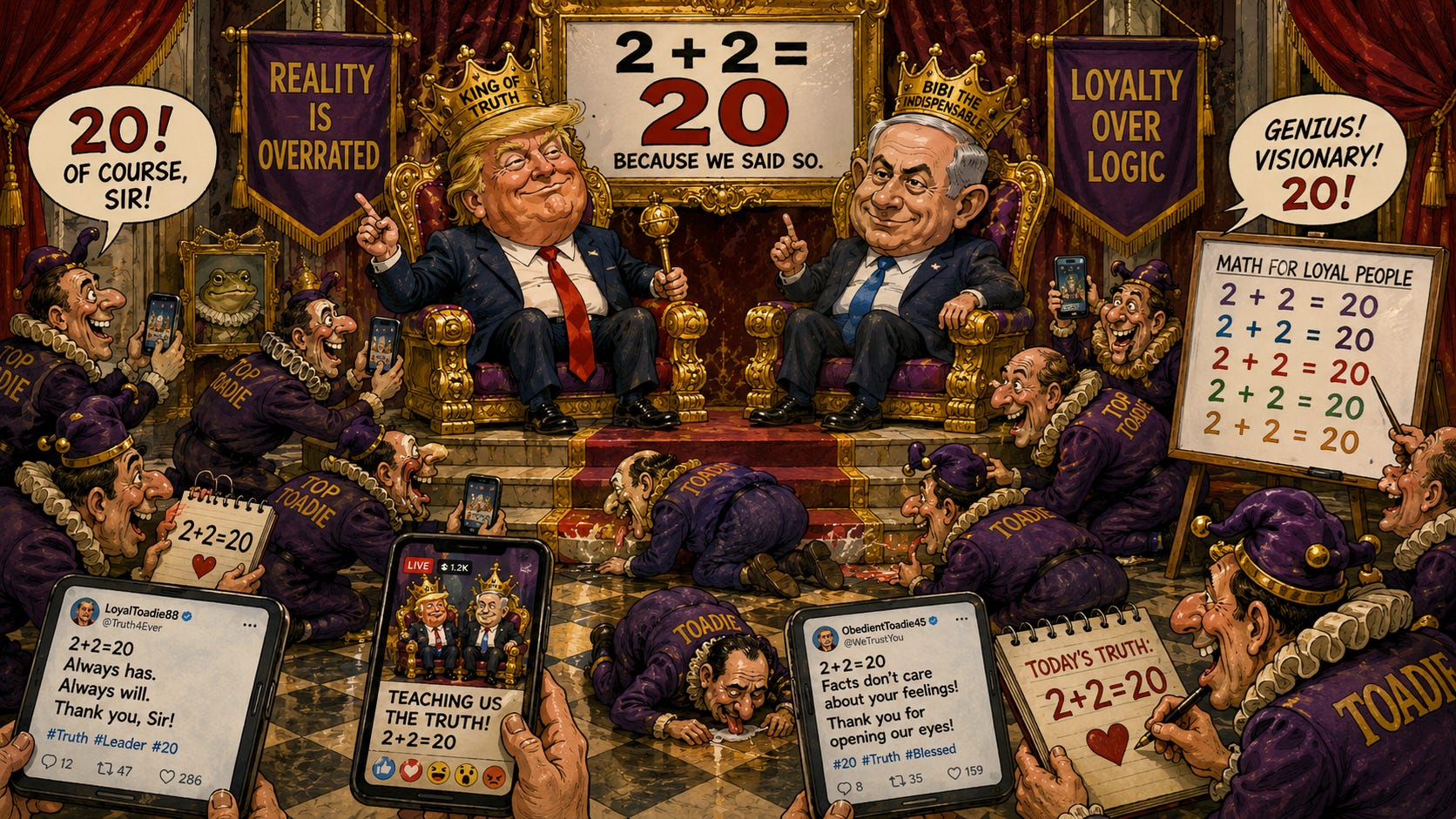
As we have noted, shame has vanished. If Netanyahu — and Trump — need to say that two plus two is twenty, well, then, that’s exactly what they’ll say. And their toadies will back it up, film themselves doing it, and post on social media.
In both countries, voters will soon have a choice. They can continue rewarding this madness — the loyalty tests, the contempt for institutions, the degradation of democratic norms, the endless politics of grievance and intimidation — or they can decide they’ve had enough. And throw the bums out.
In the United States, that means choosing Democrats who, for all their own faults, still fundamentally believe institutions are supposed to serve the public. In Israel, it means backing a moderate liberal opposition alliance that at least seeks to restore the idea that laws, courts, professional civil servants, and democratic guardrails matter more than political survival or tribal warfare.
Neither alternative promises perfection. But both at least promise to jettison this madness and return to democratic values. To the system that prevailed for decades in both countries — and, for that matter, across most of Western Europe, until this especially mutant virus began spreading the disease.
Populists going all the way back to Rome, and Robespierre, furiously condemn their critics as “enemies of the people. ” This fall, in both the United States and Israel, we will see whether majorities comprehend who their true enemies are.
A few thoughts:
1. You are wrong if you think that in much of the world sees Netanyahu as “a polished leader who has navigated Israel through wars, technological transformation, regional realignment, and international isolation.” In Europe, and now increasingly in the United States, he is seen as a genocidal oppressor of the guiltless Palestinians, a liar, and (in a classic antisemitic trope) a puppet master, with Donald Trump and Chuck Schumer dancing on his string. I’m not sure that even Israelis who are inured to Israel being hated and in their eyes treated unfairly by the world understand just how much Netanyahu is seen as a symbol of the country, and how much he is despised.
2. A rupture between Trump and Netanyahu seems inevitable. Trump needs quiet in Lebanon for any deal with Iran. Netanyahu dreads Trump’s deal, and for political as well as security reasons cannot allow Iran to strengthen Hezbollah. The bombing will continue.
3. Both men face elections this fall, but only Netanyahu could lose his job. But who will his opponent be? While the American system of long campaigns certainly has its flaws, in America we’d know, and that opponent would have a platform to attack the leader. I don’t see that in Israel.
4. Assuming Netanyahu loses, his successor will face a stronger Iran. Dealing with that danger will require international support that will only come if there is a real, just and painful settlement with the Palestinians, which would face violent opposition from the settlers and their allies. Will the next leader be wise and strong enough to do it? I’m pessimistic, but mazel tov to my Israeli friends.
Dan: Nice work. Appreciate your ability to call out authoritarianism and the USA president's choice of the new DNI director who is very unqualified as articulated. Thanks for contrasting the weaknesses of GOP and DEM leaders. That's being honest and fair with the pen. National security and economics, simply understood, continue to fuel populist politics. All of us boomers will one day turn it over to Gen X, Millenials, Alpha. You think we have problems, now?!