
America at 250
The world’s indispensable experiment is a spellbinding paradox

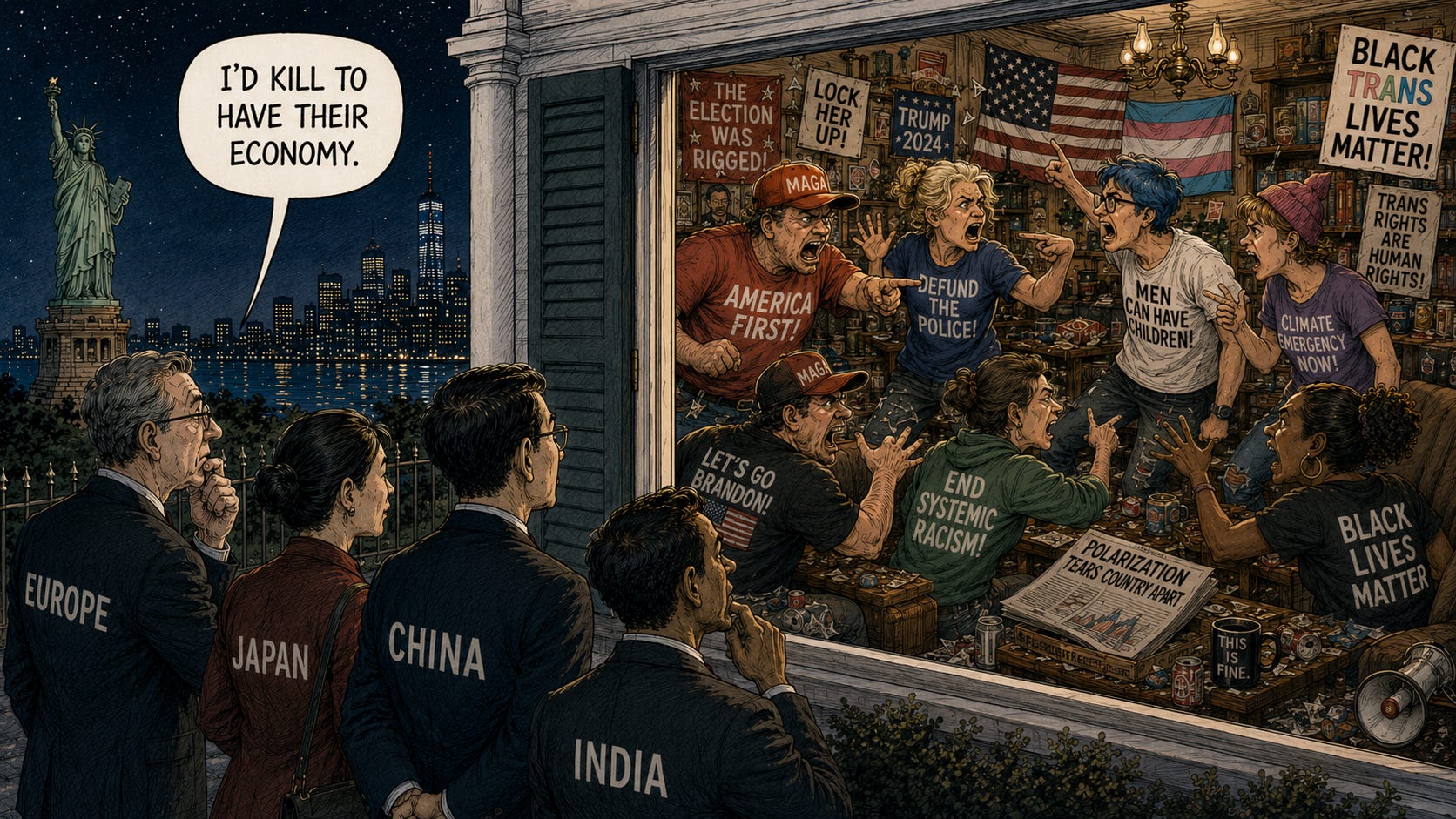
America at 250 presents one of the strangest paradoxes in modern history. No democracy has accumulated greater economic, military, technological and cultural power. Few are less content. The anniversary – in marked contrast even to the Bicentennial, despite troubles in those times as well – is being celebrated amid a hurricane of angst and anger.
Upgrade to a Paid Subscription to unlock full to AQL, support independent journalism, and anable us to afford a real cartoonist.
It can seem perplexing, because the United States remains the world’s largest economy, the dominant military power, home to an astonishing disproportion of the world’s most valuable companies and highest-ranked universities, and the principal exporter of global popular culture. American music, films, software, financial markets and scientific research influence billions of people far beyond its borders. By almost every conventional measure of success, America rocks.
Yet the other side of the ledger is equally striking. Among advanced democracies, America combines immense wealth with unusually high inequality. It spends more on healthcare than any country in the world while achieving life expectancy below many of its peers – and is the only advanced economy without a guaranteed healthcare baseline. It experiences levels of gun violence unmatched elsewhere in the developed world. It refuses to seriously regulate guns and allows states to ban abortion – both also uniquely bad. Large numbers of Americans reject scientific consensus on issues ranging from climate change to vaccination. Because of polarization, its Constitution has become a blockage on critically needed electoral reforms – or any reforms.
The contradiction – the chasm between these two narratives – is unlike anything I have seen in three decades of traveling the world’s highways and byways as a foreign correspondent. And it reflects in the surly public sentiment.
Although Americans have long viewed their country as the world’s indispensable shining city upon a hill, they now seem weirdly uncertain about its future. A Reuters/Ipsos poll found that 38 percent don’t believe the U.S. will still exist as a single country in another 250 years. Nearly two-thirds believe American democracy is in danger of failing. Gallup found that fewer than half believe everyone has an equal shot at the American dream. And an AP-NORC poll found that pride in US democracy dropped since 2017 from 42 percent to 28 percent.
How can all of these things be true at once? How can a nation so convinced of its own exceptionalism simultaneously doubt its own survival? To understand, we need to think of America as history’s largest political experiment.
The rest of this article is for Paid Subscribers. Click below to upgrade.
