
“Compute” Is a Jargonistic Scourge. Ban It!
SUNDAY READ: Tech mania is making us forget how to speak like human beings

There are words that emerge because the world changes. “Internet” was once jargon, so much so that George W. Bush had trouble saying it (low bar). So was “software.” Over time, these terms ceased to sound technical because they described genuinely new realities with precision.
And then there are words like “compute.”
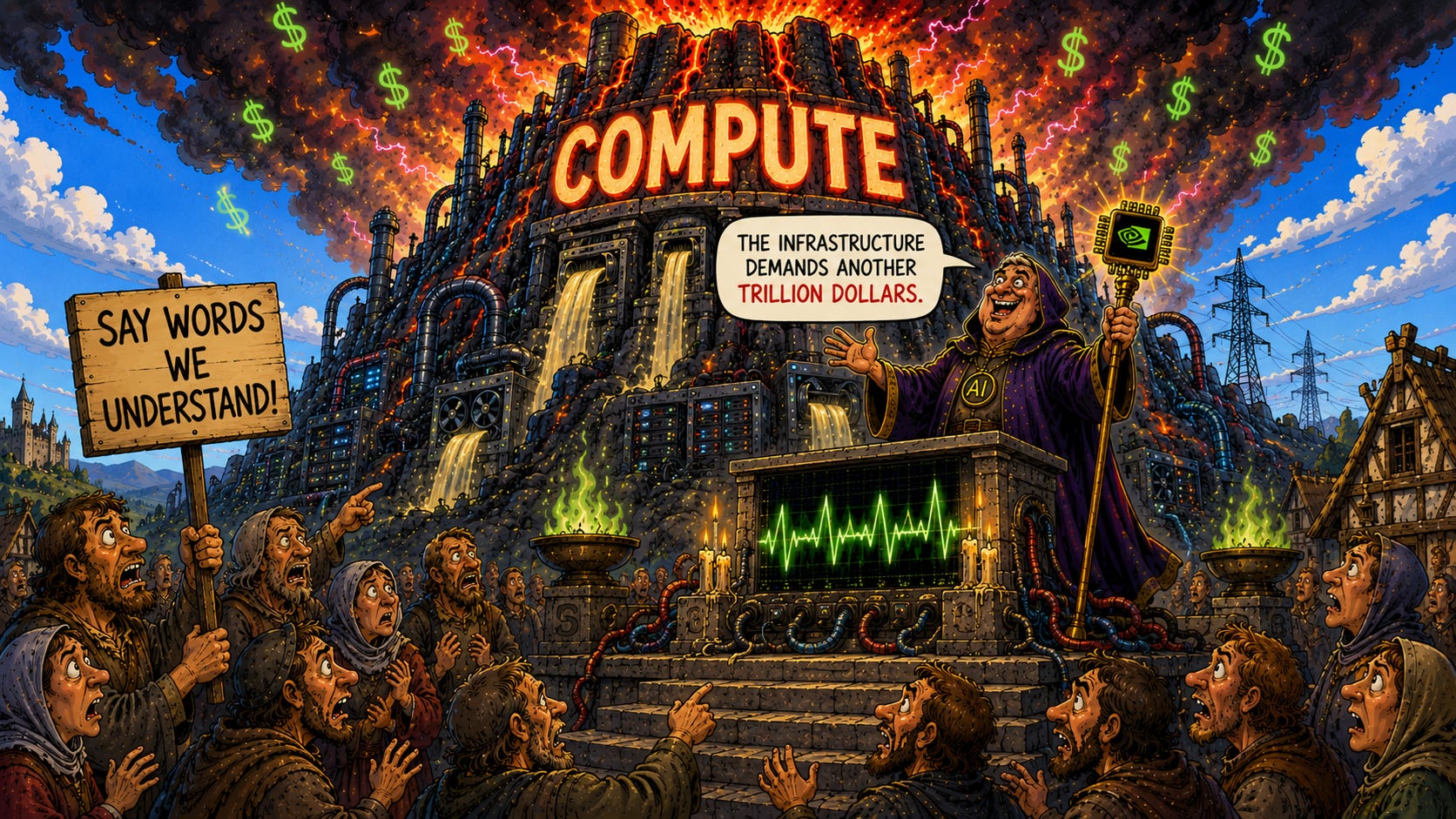
Somewhere in the last few years, Silicon Valley executives, AI researchers, consultants, and policymakers collectively decided that “processing power” was too human and understandable. So now we are told that nations must compete for “compute.” Startups “lack compute.” Governments seek “sovereign compute.” Venture capitalists solemnly warn of “compute bottlenecks” as though Moses descended from Sinai carrying NVIDIA chips. Sorry, I mean “carrying compute.”
Consider upgrading to a Paid Subscription to unlock access to all content including the Critical Conditions podcast. Really, nothing else computes.
Linguistics purists will insist that any change is simply evolution.
But I’d argue that some changes are vile, and preserving clarity in language is among the building blocks of civilization. “Compute” is a hideous mutation, committing the cardinal sin of transitioning verb to noun. Imagine if a joke were “amuse,” and the hungry lacked “eat.”
Not all technical shorthand is inherently bad. Every industry develops compressed language. Lawyers “litigate.” Physicists need “quarks.” Economists need “inflation.” Engineers genuinely need distinctions between “hardware,” “software,” “memory,” and “processing.” Good technical language narrows meaning. It sacrifices familiarity in exchange for precision.
But bad jargon does the opposite: it’s unnecessary. Gotta say, you see more than a hint of that when journalists misspell the “lead” paragraph as “lede” and invent terms like “copy” (the text), “nut graf” (the context “boilerplate”), and “kicker” (the ending). But rarely does useless jargon truly seek to enter the wider language.
With tech, English has endured several such invasions already. “Interface” once sounded intolerably mechanical when imported from engineering into ordinary speech. “Input” transformed human opinions into the equivalent of data fed into a machine — demeaningly, I’d say. “Leverage” escaped physics and became consultant shorthand for “use” (or, more bizarrely still, “debt”). “Bandwidth” mutated from telecommunications into a way for exhausted professionals to describe their availability, like a human Wi-Fi router.
First comes the ugly specialist usage. Then ambitious professionals adopt it to sound current. Then management consultants spread it like an invasive species. Finally — if we are very unlucky — the public gives up resisting and agrees to “synergize” with the updated vocabulary “stack.”
“Compute” is the latest — and if you want to leverage my input, the greatest — scourge. Nobody outside Techworld would naturally want to say it. Human beings say “computing power,” “processing capacity,” “servers” even, “machines” definitely, or “computers.” Those evoke something tangible. “Compute,” by contrast, floats in the air like a malodorous synthetic protein substitute extract.
When an AI executive says a company possesses “more compute,” what does that actually mean? Chips? Energy? Datacenters? Capital expenditure? Cloud access? GPU-hours? Engineering talent? Time? Rather than precision — which as said is the common excuse for jargon — it enables bureaucracies to collapse all these into abstraction. It sounds scientific without requiring specificity — the hallmark of modern professional language, which often seeks not to clarify but obfuscate.
George Orwell warned about this decades ago in the essay Politics and the English Language, and in novel form in 1984. Euphemisms spread because they anesthetize the mind. Civilian deaths become “collateral damage.” Propaganda becomes “strategic communications.” Mass surveillance becomes “data collection.” And planet-endangering infrastructure becomes “compute,” as though we were discussing rainfall rather than gigantic warehouses of electricity-devouring machinery owned by trillion-dollar corporations.
The term also reflects Silicon Valley’s alternative universe in which everything can be reduced to quantifiable inputs. In this worldview, intelligence itself becomes a “resource extraction” problem: pour in enough chips, electricity, and training data, and cognition emerges automatically. Creativity, discovery, art and language become functions of enough “compute.” Human or not, it is all the same.
“Compute” also completes the transformation of computing from an activity into a commodity. A century ago, a “computer” was a person with mathematical training performing calculations by hand. The machine inherited the name, and today the human is gone, with only industrial capacity remaining. “Compute” sounds like something mined from the earth, like lithium or natural gas.
Indeed, AI infrastructure increasingly resembles heavy industry more than the old romantic image of garage startups. Vast datacenters consume staggering quantities of water and electricity. Governments discuss chip supply chains in geopolitical terms. Nations worry about “compute dominance” the way they once worried about oil reserves. Yet instead of developing language equal to this transformation, we are at risk of accepting a word that sounds like a placeholder accidentally left in a PowerPoint presentation.
I think, though, that we still have time. Most people probably have not yet heard of this linguistic menace, and there is a chance at some pushback, as there wasn, in a wholly different context, with the scourge of “LatinX.” So when I urge media in the headline to “ban” it, I’m really saying something more plausible: back away from it carefully, like from a fire-breathing porcupine ridden by Elon Musk.
This is especially because “compute” attaches, too, to the peculiar sociology of Silicon Valley itself — and that is a culture that is increasingly at loggerheads with mainstream opinion, for a whole array of reasons (mainly, threatening jobs through AI, sanity through social media algorithms, probity through dirty deals with the government, social cohesion through outrageous concentration of wealth, and good karma via its superiority complex).
Tech culture prizes terseness, optimization, and insider fluency. To say “compute” signals membership in the club. It demonstrates familiarity with the discourse of AI scaling laws, venture capital, and “hyperscaler” infrastructure. Like much jargon, the word functions socially before it functions intellectually — which helps explain why such language spreads so quickly.
Every professional tribe develops verbal handshakes — words that separate insiders from outsiders. There is a small thrill in fluency, in hearing an opaque term and immediately grasping its meaning while others remain slightly confused. One can almost watch the “micro-aggression” of satisfaction flickering across the faces of conference-goers thrilled to share a kind of priestly status by virtue of taking the same absurd word seriously.
Silicon Valley’s version is especially aggressive because the industry sees itself not merely as successful, but historically transformative. Its jargon therefore acquires an almost theological quality. If anyone doubts this God complex, they should listen to Peter Thiel, who speaks as though democratic systems are obsolete or inadequate and “frames” technological elites as the real “drivers” of history.
Good Lord! Now I am using jargon! Why are we so weak? Is it a lack of compute? Or have I joined some priesthood myself?
One thing is clear: the more machines are sounding human, the more humans are sounding artificial. That may just be the point. Is anything truly real? Act while you still can.
Don't worry, Dan, we already have the "pour" and the "ask" and countless other cute short zingy terms which transform verbs into nouns to sound "in" (we used to say "with it") and somehow it doesn't offend in context. We need to choose our appropriate jargon for the scene we're in, beginning with whether it's spoken or written.
Where the hell did "woke" come from?
Being "of the now" - topical? - is a short-lived gut-boost anyway.
Hebrew has made acronyms into words (of which few people even know the origin) and French has long compressed its many 4-syllable words into two. I guess devotees of "compute" get a buzz every time - for as long as that one lasts. Compared to other things, not particularly scourgifying...
damn right! It makes no sense. It's confusing as shit.