
Getting Our Bearings
SUNDAY READ: How a language built at sea and forged in battle came to steer the world

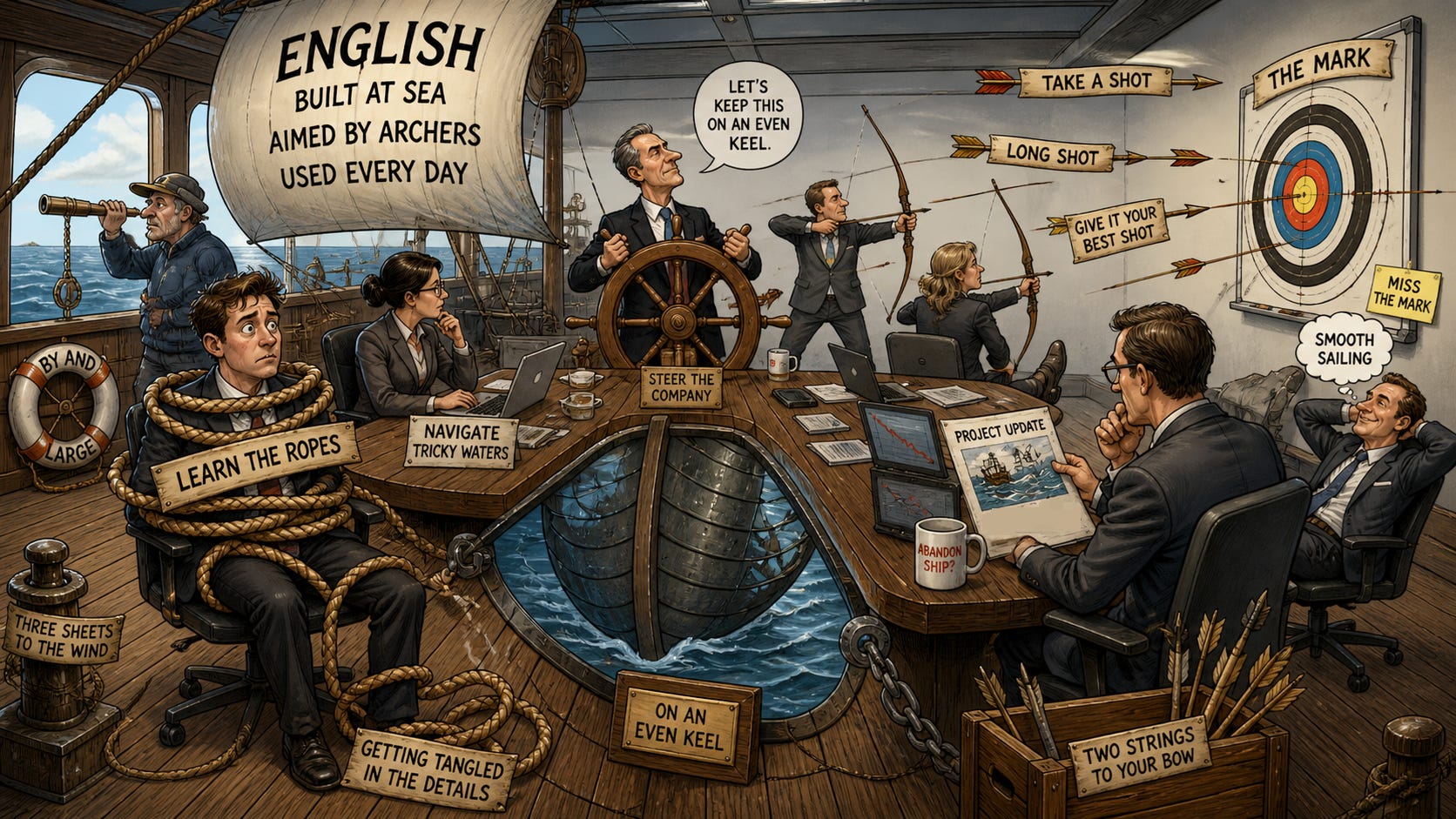
It’s remarkable how you can spend decades believing you’re observant and still miss something hiding in plain sight. For instance: how much of everyday English comes straight from the deck of a ship. I was recently made aware of this by an English literature professor who was three sheets to the wind. As it were. And as I am in my adopted hometown of London, it is top of mind.

We learn the ropes, try to keep things on an even keel (the keel being the bit that stops the whole maritime thing from tipping over), hope for smooth sailing, and admit we’re at sea when we haven’t the faintest idea what’s going on. By and large (a ship that could sail both into the wind and with it, meaning it handled most conditions without embarrassing itself), we conduct modern life as though we’re all minor functionaries in a slightly chaotic navy.
Consider an upgrade to a Paid Subscription. You’ll be enabling independent reportage and commentary, joining a growing community, and unlocking access to all content.
Once you notice it, it becomes difficult to unsee. Office conversations begin to sound less like strategic planning and more like instructions being shouted across a windy deck. Projects drift, teams steady themselves, managers try not to rock the boat, and every so often someone quietly considers whether it might be time to abandon ship. No one finds this strange.
Archery turns out to be just as deeply embedded, though it tends to arrive with less ceremony. We aim to hit the mark, give things our best shot, and describe anything ambitious as a long shot (meaning: admirable, though perhaps optimistic). When things go wrong, we miss the mark; when they go right, we line up a target and take aim.
Which raises a question: how did a damp island off Europe’s edge end up determining the metaphors through which half the world now conducts its business?
For centuries, England kept one eye on the horizon and the other on not being invaded. The sea offered opportunity, though it demanded a certain competence. Ships are famously unforgiving environments; vague instructions tend to result in immediate feedback. Language evolved accordingly. Sailors developed a vocabulary that could survive stress, clarify action, and avoid the sort of misunderstandings that end with someone in the water.
Meanwhile, on land, the longbow was doing something similar for thought itself. Archery rewards focus, repetition, and the ability to judge distance without drama. You aim, you adjust, you release, and you live with the result. Over time, that rhythm found its way into speech. People began to describe ideas as though they needed to land somewhere specific, preferably on target and without causing collateral damage.
Then the whole system caught a favorable wind. Ships carried not only goods but language, dropping anchor in places that had little interest in English weather but a growing familiarity with English administration. Empire did what empire does: it extended reach, set patterns, and left behind structures that proved inconvenient to dismantle. English spread not because it was inherently superior, but because it was there, attached to power, trade, and the occasional war.
Later, another force took the helm. The United States, arriving with industrial scale and cultural confidence, pushed English into every available channel. Film, finance, aviation, software. Of there was a system to be built, it was run in English. Silicon Valley did not invent the language, though it embedded it into the daily mechanics of life. If Britain launched the vessel, America ensured it would be very difficult to disembark.
The result now feels less like a choice and more like the water everyone swims in. Meetings in Tokyo, pitches in Berlin, and research in Sao Paulo proceed in the same language, guided by the same familiar phrases. Teams align, strategies stay on course, and risks are navigated as the arrows keep flying.
Which leads to another question: why do some periods gather force and reshape everything in their path, while others drift by politely, leaving little behind?
History, like a poorly managed vessel, tends to alternate between long stretches of calm and moments of sudden, collective panic. Most of the time, things tick along. Then, occasionally, new technologies appear, trade expands, ideas spread quickly enough to find their mark, and suddenly everything is moving at once.
The early modern period managed this trick rather well. Printing multiplied ideas, exploration connected continents, and political systems adjusted to keep up. Each development reinforced the others, creating a momentum that proved difficult to resist. Later, industrialization, mass politics, and global conflict combined to redraw maps and expectations with alarming efficiency. In each case, multiple currents converged, and once the tide turned, it carried everything with it, whether anyone felt particularly ready or not.
Language tends to go along for the ride. English did not simply drift into its current position; it caught a series of favorable winds — empire, industry, technology — and held its line as they strengthened. Over time, this became self-reinforcing. The more people used English, the more useful it became, and the more it shaped how ideas were framed. At a certain point, it stopped feeling like a tool and started feeling like the environment itself.
Which brings us to a final question: why is it worth noticing any of this?
At one level, it isn’t. Emails still need writing, meetings still need attending, and most long shots still fall short despite everyone’s best efforts. Yet once you take stock, it becomes difficult not to hear what’s happening underneath the surface. We think we’re having thoughtful discussions, yet we’re navigating tricky waters; we believe we’re weighing options, yet we’re obsessively lining up a shot. Plans stay afloat or sink; ideas land or fall short. The metaphors do not introduce themselves, though they quietly steer the conversation all the same.
Recognizing this does not change the destination, but it does sharpen the sense of direction. It becomes easier to tell whether you are making headway or simply drifting, whether an argument holds steady or is about to capsize, whether a proposal is well-aimed or destined to land somewhere unfortunate. Language, in this sense, is doing more work than it lets on.
There is also a small, slightly satisfying shift in perspective. A routine meeting begins to resemble an exercise in keeping balance and taking aim. A familiar phrase reveals traces of a world in which sails needed constant adjustment and arrows demanded a certain discipline.
And so the next time you pause to take your bearings, it may be worth noticing how much of the work has already been done. The language has set the course, trimmed the sails, and lined up the shot. All that remains is to follow through and orient ourselves.
By and large (with “by” meaning sailing into the wind and “large” being with it), that turns out to be enough. We are, in a way, ship shape.

Good story for hard times. I love reading about language. It always amazes me where words come from and how their meaning or spelling changed over time. Or that one culture adopted words from another and now claim them as their own. Our English Language has benefited when people interact with others who speak different languages, which adds to how we communicate. To use a word that Shakespeare used, how silly are we to use words and phrases that are “out to sea.”
Great article, Dan, must have taken some time to compile the information.
If you’re in London, visit the London Library, near Piccadilly Circus, with its great collection of books, including on maritime topics, and one can browse them. For non-members, there is a nominal fee to use it.
Three years ago, I visited San Diego. At the northern end is the Scripps Institute of Oceanography, beautiful site bordering the Pacific Ocean. Nearby is the Salk Institute for Biological Studies, a tourist attraction.
The famous poem ‘’Sea-Fever’’ by John Masefield, taught in high school.
Jacob Mendlovic, Toronto