
Ghosts Over Berlin
The strange calm of a reunited city where the past is everywhere and nowhere

I first visited Berlin in 1988. It is incredible to recall that those were the last days of the Cold War, and that we had absolutely no idea at the time. Almost nothing animating our lives now was visible then, yet we had the arrogance of certainty.
My friend Alfred was a US vice consul at the Embassy in East Berlin (the West Germany embassy was in Bonn, John Le Carre’s proverbial “small town in Germany”), so he had the ability to escort me across Checkpoint Charlie. Unpleasant officers rifled through my passport and waved our car through — diplomatic license plates. It was like crossing over to the dark side of the moon. I had never been in a communist country.
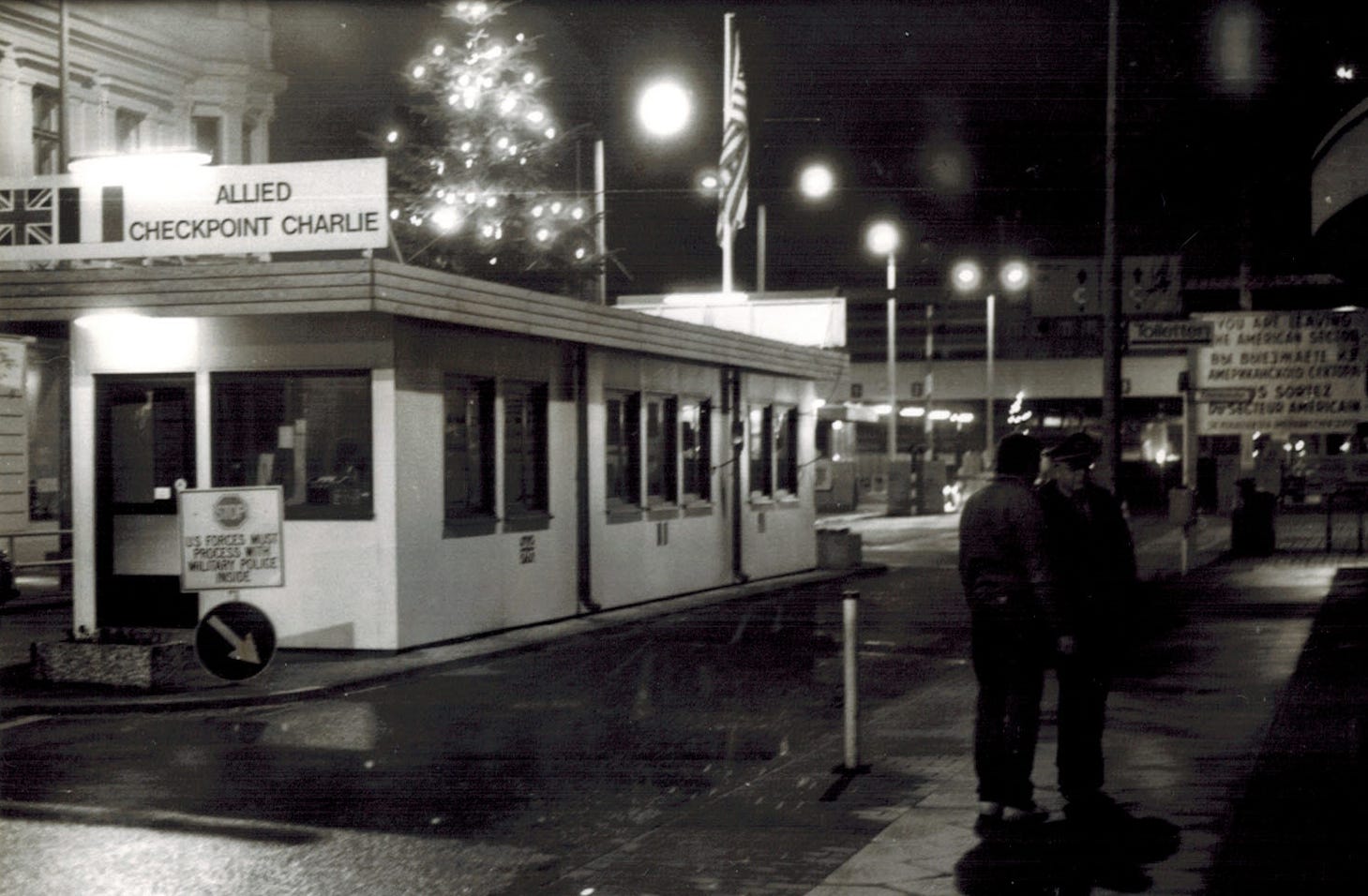
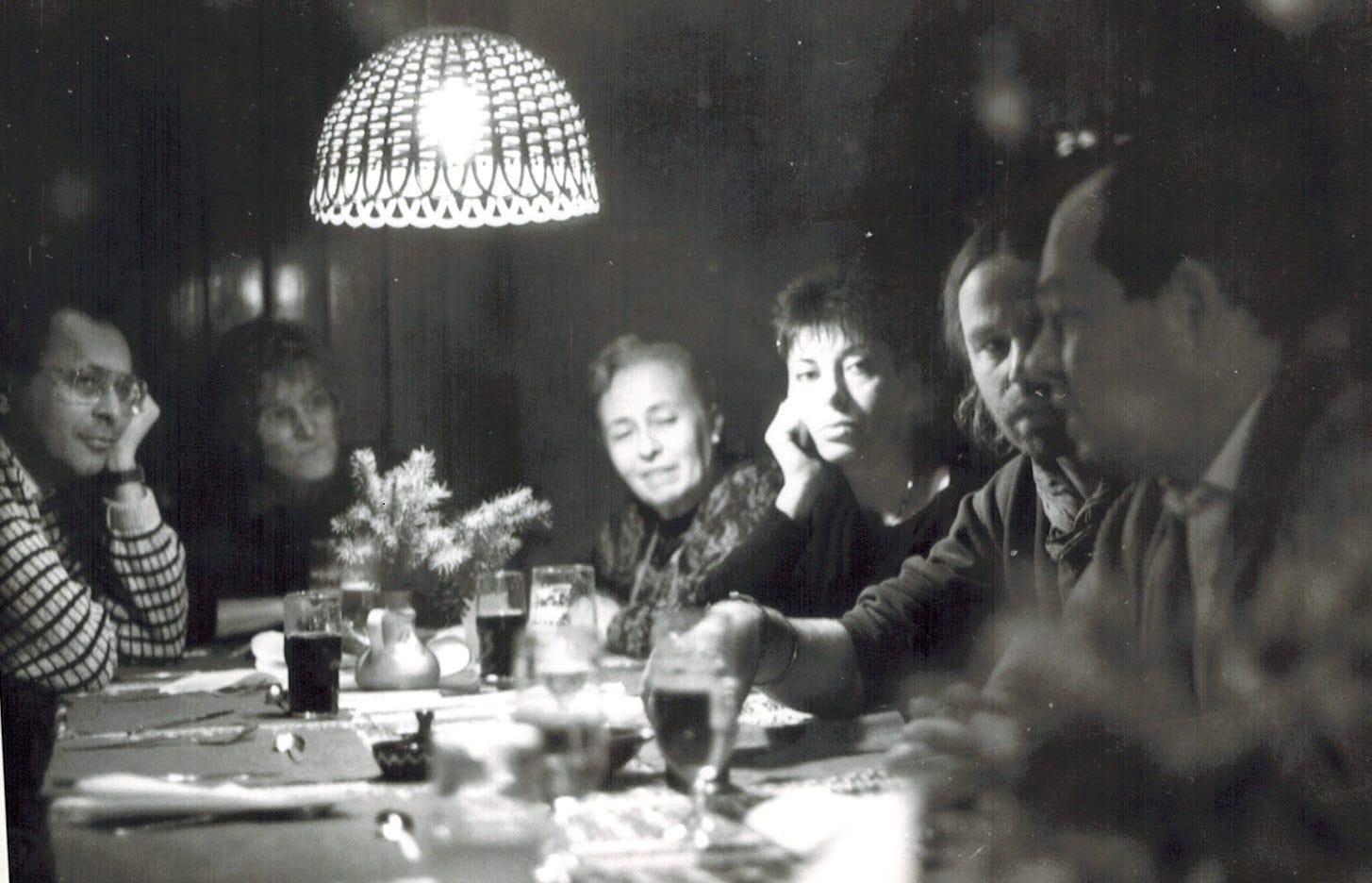
It was striking how the two parts of the city, separated by a snaking wall built in 1961, seemed so completely different. Not only because the West was prosperous — BMWs, vibrant street life, stylish shop windows, and the casual bric-a-brac of late 20th century Western contentment (now partly gone), whereas the East offered drabness, Trabants, sparse street lighting and palpable fear. I met with some dissidents and felt like the spy who came in from the cold. One lamp. Vodka.
The halves also felt different cartographically. The West was a sprawl heading off in all directions, anchored by the Kurfürstendamm running diagonally like an arrow cheekily pointed at capitalism itself, yet encircled by East Germany. The main part of the East was a grid — Prussian, disciplined and lifeless.
Only later did I realize that the East was, in fact, the former imperial capital. Those grand, heavy, monotonous buildings were the historical core of Berlin, subdued by the humorless, soul-emptying anvil of Soviet communism.
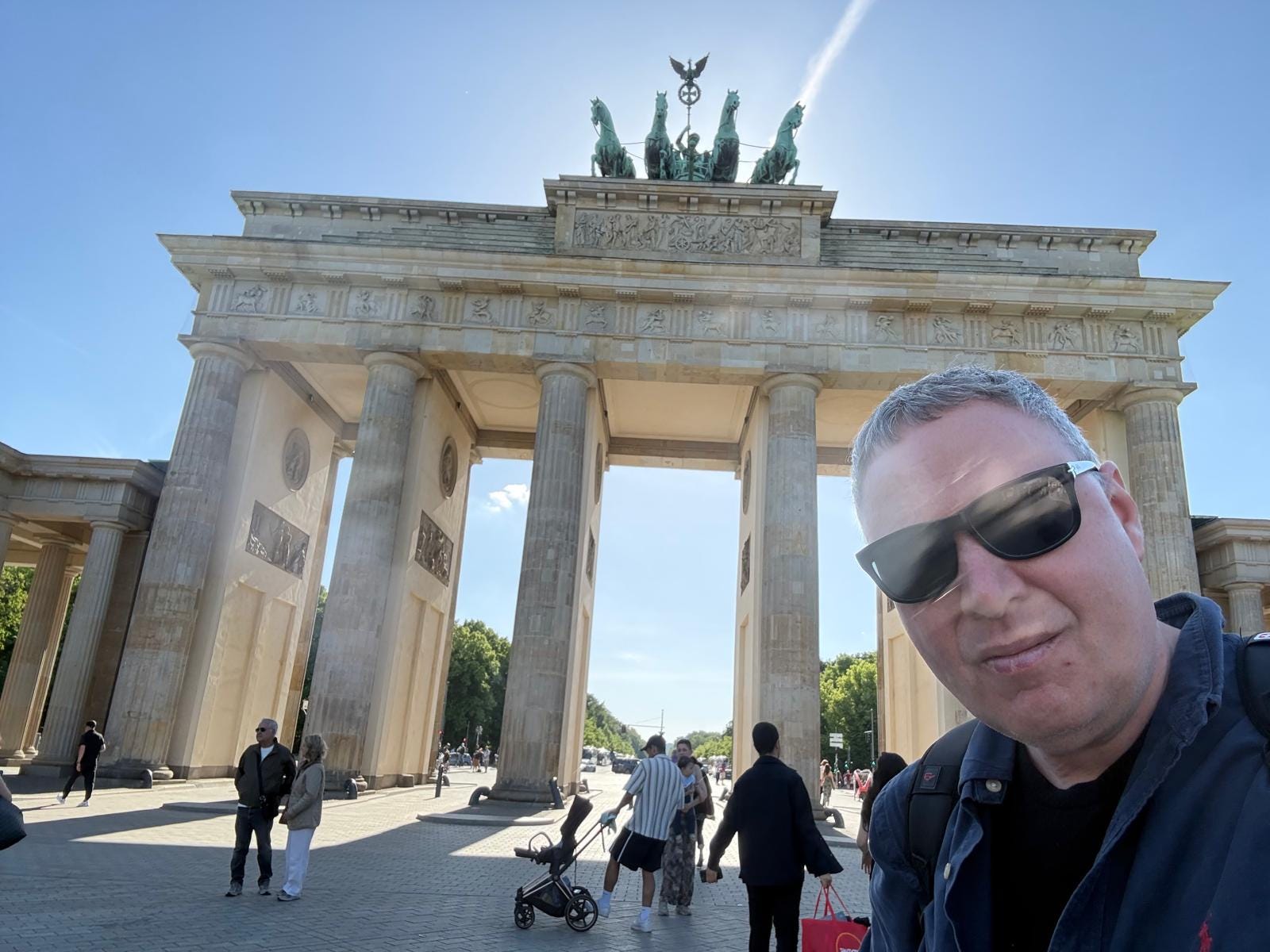
I went then to the Brandenburg Gate, which is as close as Berlin comes to Paris’s Arc de Triomphe. It too sits at the end of a massive straight boulevard, the Unter Den Linden, which was in the East. You could not cross through the Gate. The hideous concrete wall ran right alongside it, trapping the monument in the East, along with tens of millions of human victims.
Consider upgrading to a Paid Subscription to unlock access to all content including the Critical Conditions podcast
This week, on another trip to Berlin, I stayed right by the Unter Den Linden. Checkpoint Charlie, a short walk south on the Friedrichstrasse, has become a small monument mobbed by tourists. I walked to the Brandenberg Gate, now as then, approaching it from the east. There were bicyclists everywhere; Berlin has a thing with green transport. The weather was good.
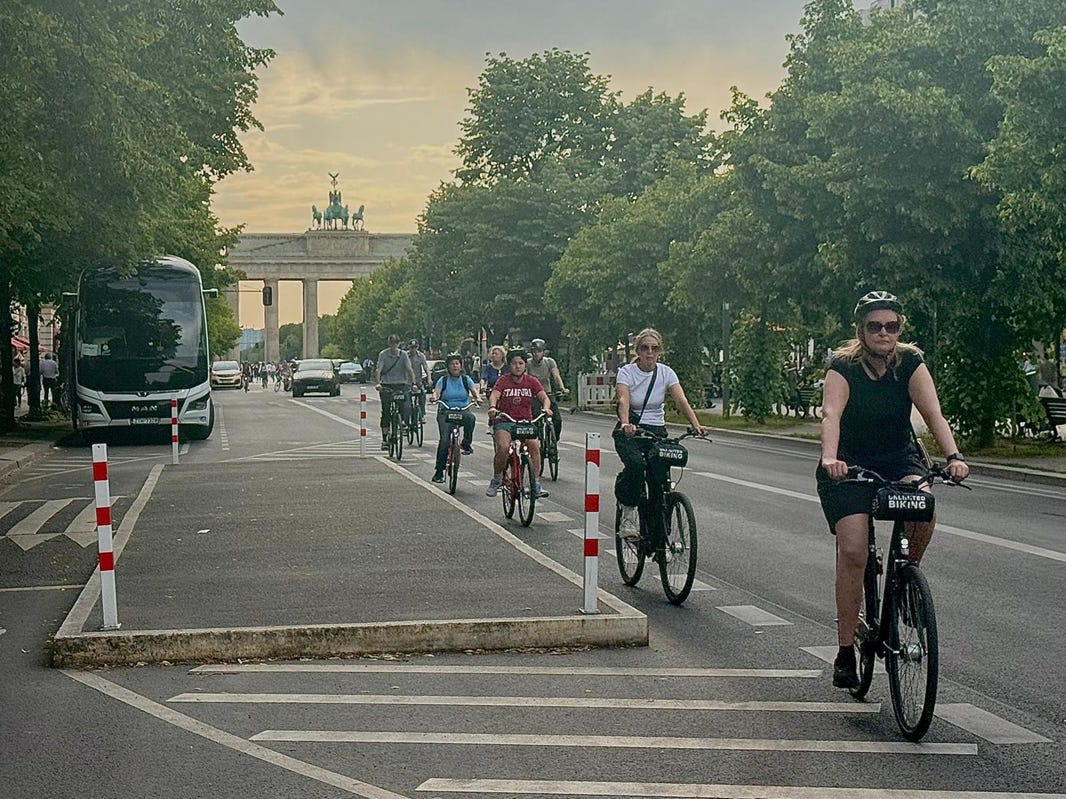
I strode right past the Gate, as if making a statement. Just off to the right of the monument, at a beer garden, I met my friend Ulli. So pleasant and normal – nothing remains anywhere to remind you of the Wall. I recalled Ronald Reagan’s speech, right at that very site: “Mr. Gorbachev, tear down this wall!”
It is another thing we could not have known at the time: he actually did. In the fullness of time, I was to meet Gorbachev in Moscow and thank him. He seemed surprised by what he had unleashed, and proud to have done a Pizza Hut ad. He was also very careful not to criticize Vladimir Putin. Sic transit gloria mundi.
The official name is the Memorial to the Murdered Jews of Europe, though almost everyone just calls it the Berlin Holocaust Memorial. It sits just south of the Brandenburg Gate, on ground loaded with symbolism — near the former Nazi government quarter and not far from Hitler’s bunker. Ulli and I stood in front of the field of gray concrete slabs rising anf falling in uneven waves beneath the Berlin sky. From a distance it looks weirdly orderly; inside it becomes disorienting, claustrophobic. The city disappears.
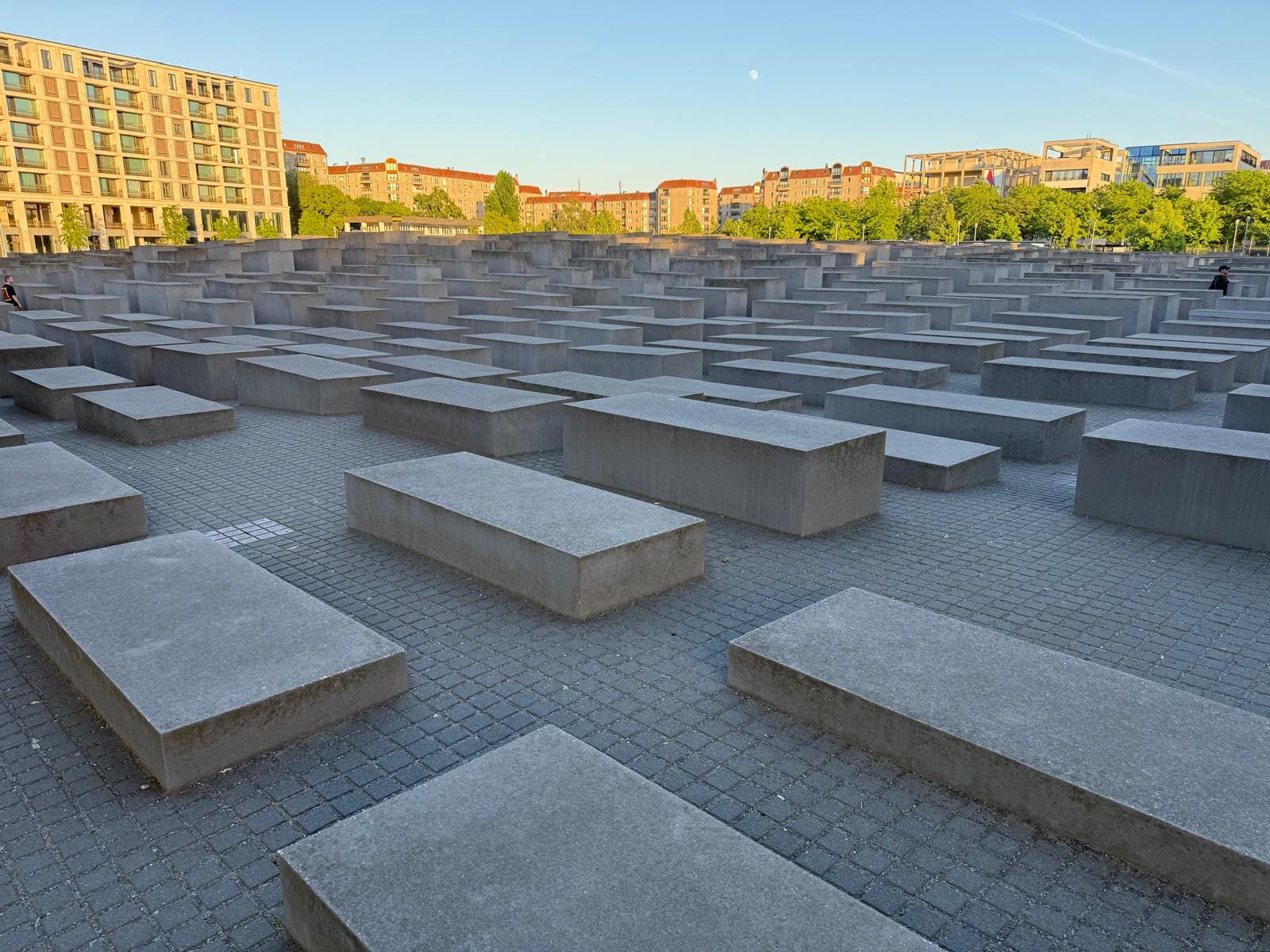
It was designed by the American architect Peter Eisenman, after years of fierce debate in Germany over whether and how the Holocaust should be memorialized in the center of the former Nazi capital, Eisenman’s design was chosen in 1999 and the memorial opened in May 2005, sixty years after the end of World War II.
Eisenman, it is said, deliberately avoided explicit symbols like crosses, Stars of David, names, or statues. He wanted the memorial to evoke feeling rather than narrate history directly. That abstraction has always been controversial. Some critics think the lack of explicit historical explanation makes it too vague or emotionally cold. Others think ambiguity is what gives it power.
I asked Ulli how it could be that this happened.
“What, the memorial?” Ulli asked. “They commissioned it.”
“No, man, the Holocaust.”
I said there was very little in German culture that seemed to predict such a thing. If you read Mann, if you consider Martin Luther, there is nothing there to suggest such evil in any straightforward way. Not even Strauss or the much-misunderstood Nietszche. Now the Russians – with their pogroms and their frozen tundras and dark manias! They seemed somehow more plausible.
“It is not evil. We are something else,” Ulli said, then paused. “Ach, my English.” He began to fumble with his phone, searching on his translation app while I considered the dispiriting slabs.
“Ah yes!” he cried. “Relentless. This is the word. We are relentless. When we start to do something, nobody does it with such relentlessness.”
This made sense. I recalled a story of a woman from Israel discovered on a light rail train in Germany by a ticket inspector after her two-hour pass had expired. She did not know about the time limit and tried to explain, but the uniformed fellow would have none of it. He sternly ordered her off the train and made sure she paid the 60 euro fine on the spot. Her protestations, and those of her friends, had no effect. Rules are rules. But not so much in Israel. Someone joked that it was a new experience for Jews to be taken off a German train. Someone else laughed. The sound of that laughter — this is the sound of 81 years passing.
“That ticket inspector was relentless,” Ulli observed, his theory proven.
I told Ulli, who is a military man, that Germany needed to spend more on its defense. Your screw-up in World War II was obviously epic, I said, and you certainly were relentless about it — so we were all afraid of another German military machine. “But with America being what it has become — and I do not know if it is permanent — it’s time that you guys handled your own defense against Russia,” I advised. Ulli did not disagree.
And let’s face it, I added. Germany plus Austria and Switzerland (mostly Germanic both) is over a hundred million people. Russia these days has not that many more – and you’re infinitely more serious. Do you really need favors from the Americans? “Yes, Russia is a gas station masquerading as a country,” Ulli agreed, but added that it has nukes and Germany has no second-strike nuclear capability. “You have the French for that,” I said, arguing that France, Germany, and Britain together could form a credible European defense architecture.
Ulli noted that the British military has been much diminished in the past forty years. “They have very nice uniforms, however,” he said. Having recently been in close proximity to British pomp and circumstance, I could only agree.
The decline of the British armed forces is undeniable. The Royal Navy once fielded around fifty destroyers and frigates in the late Cold War period; today it has fewer than twenty. The RAF has fallen from several hundred combat aircraft to roughly 150 fast jets. The army has shrunk from over 150,000 regular troops to around 70,000, its smallest size in modern history. Britain still retains elite capabilities — nuclear submarines, intelligence, special forces — but its capacity for sustained conventional warfare has been reduced. From meetings during my London trip I assess they know it and will take remedial action. In due course.
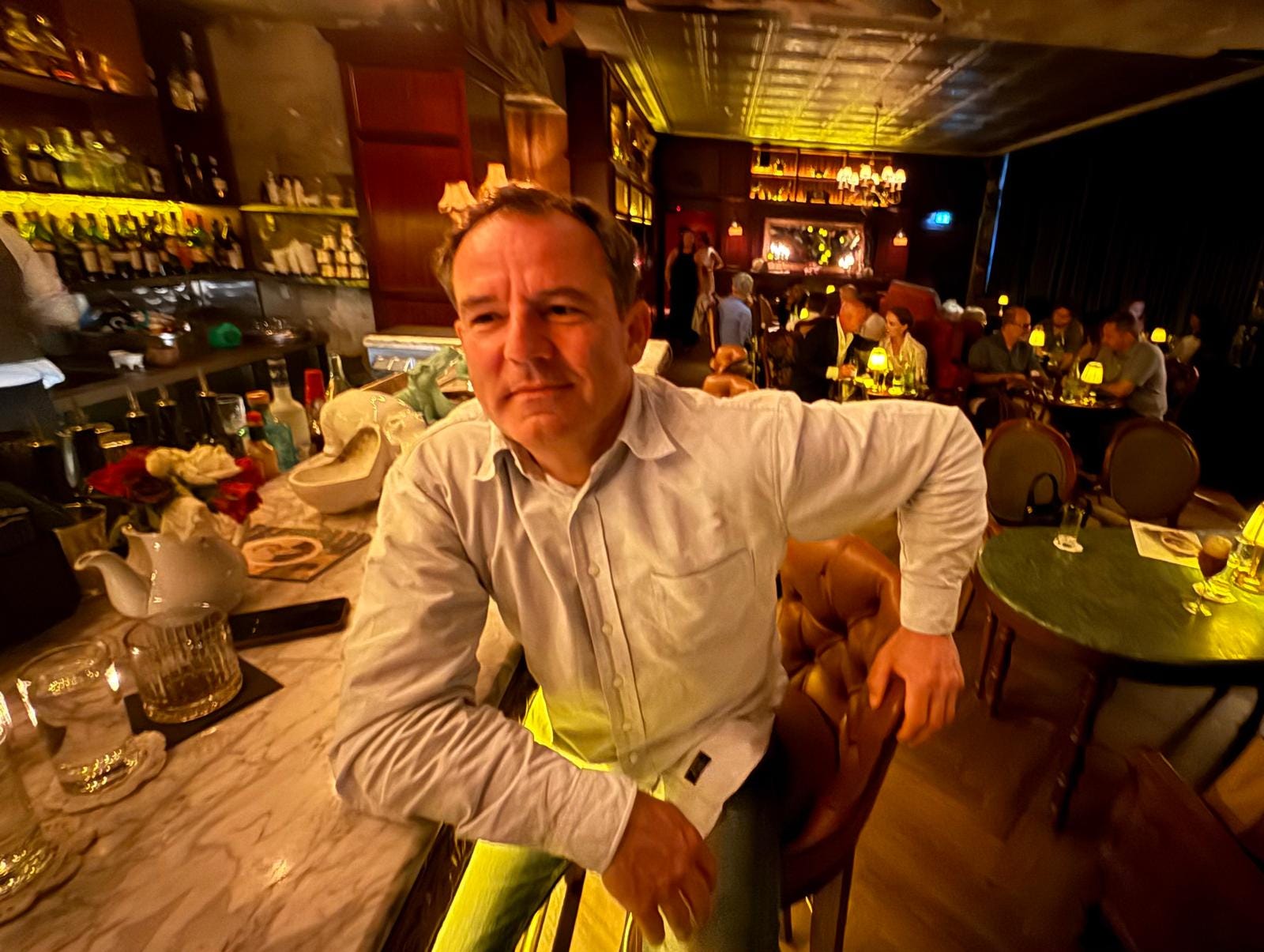
We proceeded to a bar Ulli likes called The Bellboy. It was a speakeasy, all dark wood and controlled secrecy. An elegant man behind a huge oak counter asked if we were expected. He whispered something into a phone. “My colleague will come and get you.” We waited about thirty seconds until a side door opened and a blonde young woman beckoned. Inside, it was plush seating everywhere, a beautiful bar, elegant, attractive people. We were assigned seats 104 and 105 at the bar with military precision. The insignia on the menu seemed familiar to me.
I asked the bartender, “What’s the story of this bar?” He looked around furtively. “The story?” he said. “Of this bar?” “Yes, the story,” I replied. The music was not loud but syncopated, as if to guide but not dominate conversation. “It first opened a branch in Tel Aviv,” he said. These days, people say “Tel Aviv” with some discomfort, perhaps fear.
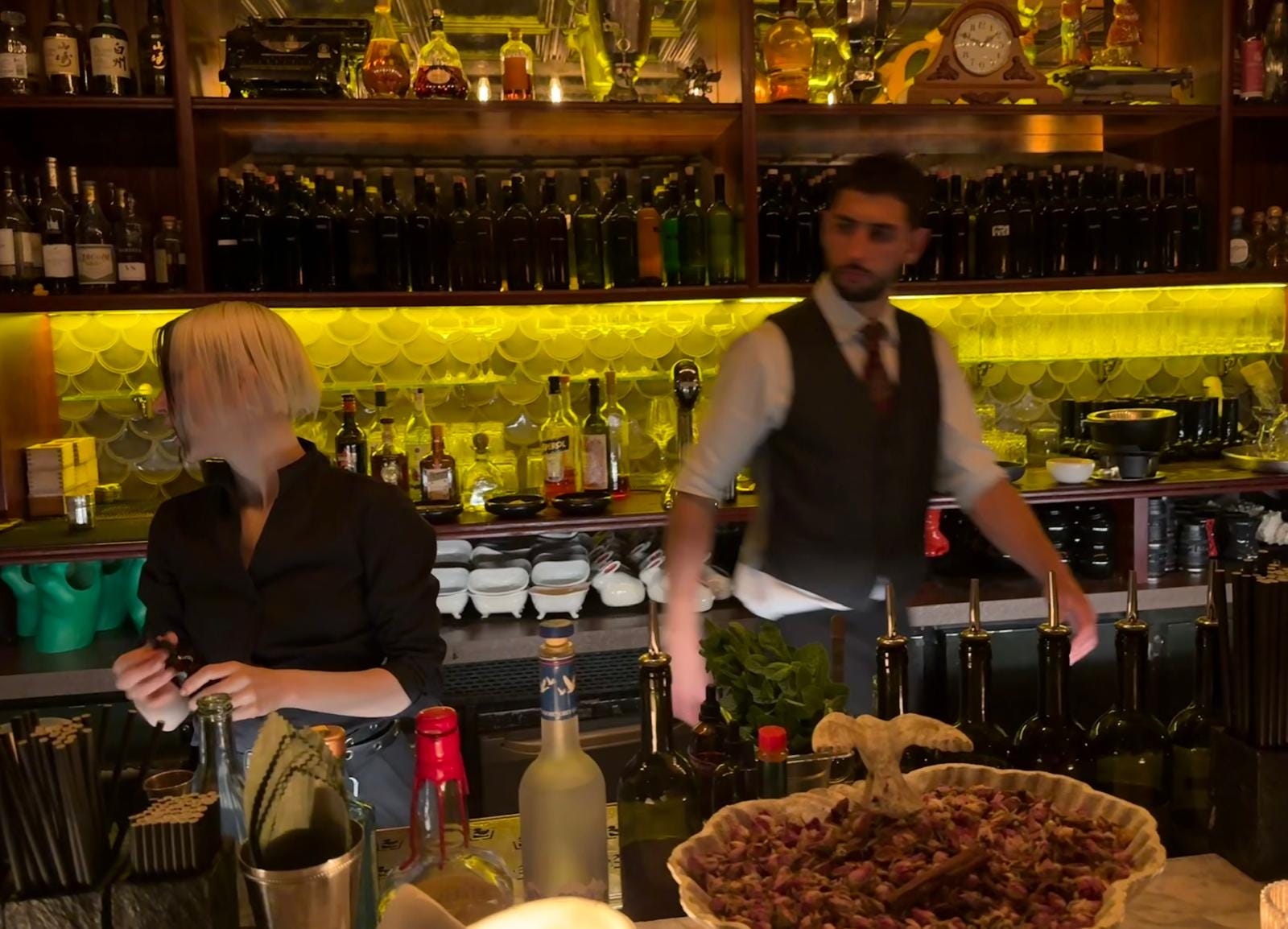
“I knew it!” I told him. “I have been there and they look exactly the same.” The bartender smiled, briefly, as if confirming a shared piece of private knowledge. Or was it a scowl? Such a fine line.
Ulli ordered a Long Island Iced Tea. “I do not have Diet Coke for a Long Island iced tea,” the bartender said. Ulli moved to rum. He was already planning a visit to a wine bar in Charlottenberg. He loves this city, which is both understandable and a joy to behold. He has a pad in the city. A cottage in the sticks. Lebenstraum.
The next day my wife dragged me to the Gemaldegalerie, which is the kind of thing she does whenever we travel (careful readers may recall a similar report from London). It is a place that does not fully announce itself from the outside, lacking the grandeur of the Louvre or the British Museum. But inside, it is overwhelming: room after room of European painting from the Middle Ages through the eighteenth century, assembled with the kind of German seriousness that borders on the fanatical. Relentless, I suppose you could call it.
My wife loves the Dutch master Vermeer – and this museum, it seems, possesses one of the finest collections of his paintings. Soft daylight entering a room. People lost in thought. Domestic scenes treated with the gravity of revelation.
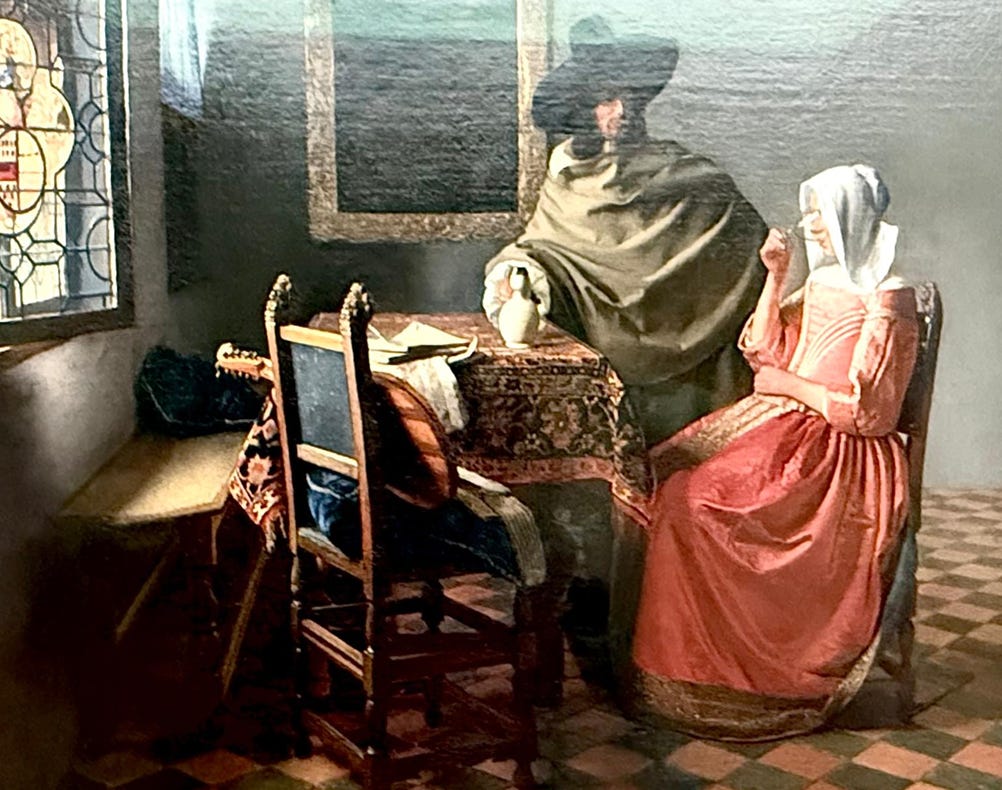
I have heard her pitch on him many times.
Of course Jesus is everywhere. As are angels and cupids hovering over naked persons massacring each other for reasons unclear. A little like the recent past in this city, to be fair.
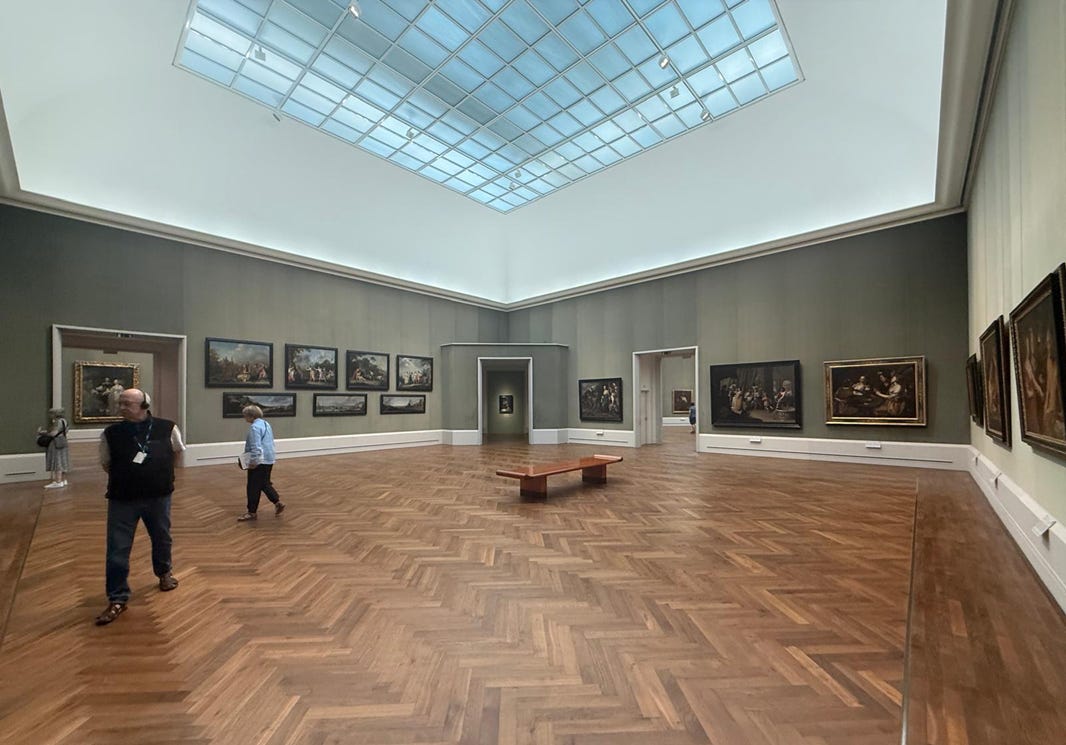
As we were leaving we noticed a sign: “The Kaiser Friedrich Museumsverein commemorates its Jewish members who were subjected to increasing persecution during the National Socialist dictatorship (1933-1945).” It turns out that Jews were a majority of the members of this museum, which has essentially been rebranded.
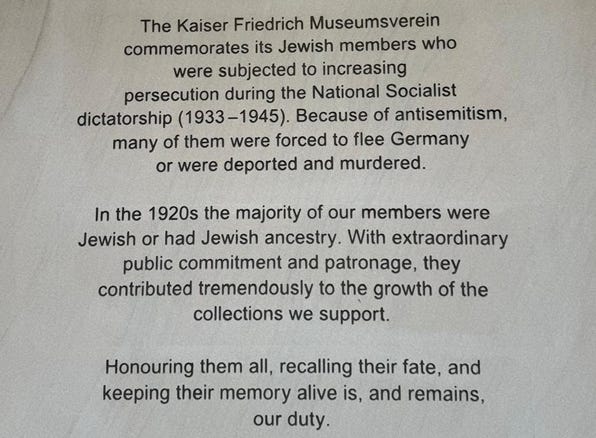
Nearby was another plaque with the names: Rosenberg, Werner, and so on. “Because of antisemitism, many of them were forced to flee or were deported and murdered. Honouring them all, recalling their fate, and keeping their memory alive is, and remains, our duty.”
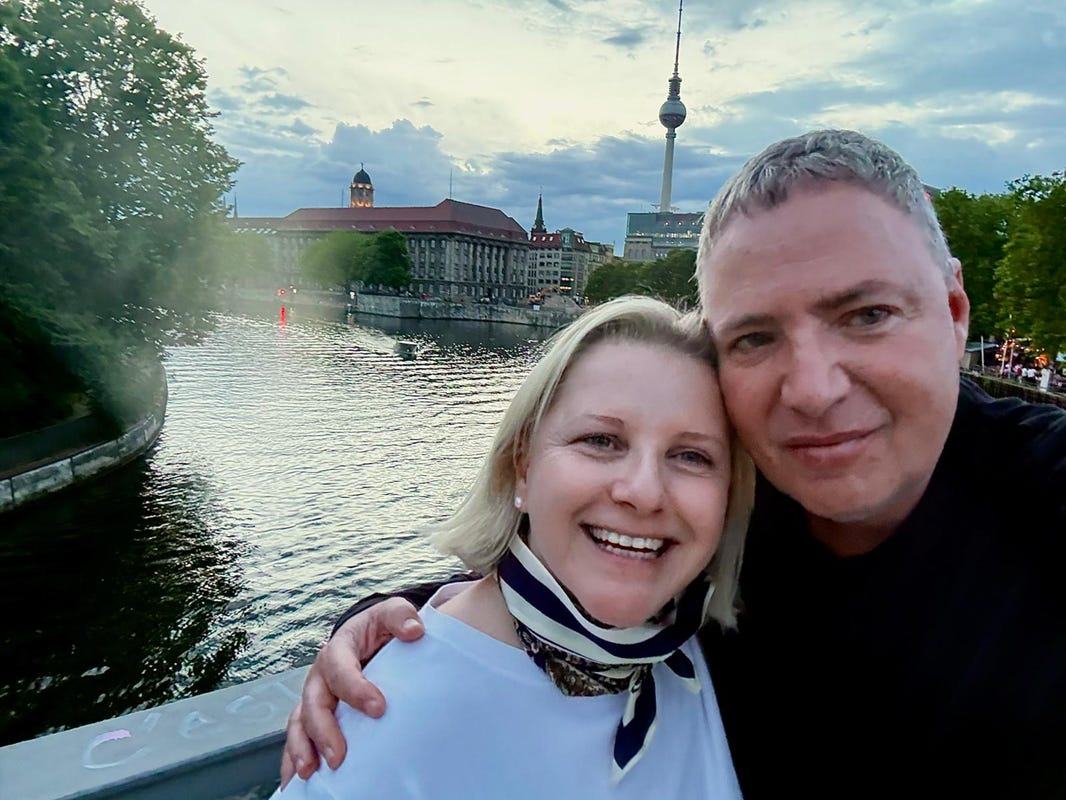
Soon the wife and I found ourselves walking along the Spree River with Alexanderplatz looming behind us, marked by the iconic tower I remember from 1988. Back then we were all sure it was a spy contraption, key to the Soviet effort in the Cold War. Today it is just a goofy erectile structure out of a cartoon.
In Charlottenburg, Ulli insisted on a pilgrimage. We walked to the baroque splendor of Charlottenburg Palace and settled on the broad stone steps, gazing across the immense gardens stretching toward the distant park. It was a scene made for reflection, or perhaps for the settling of old scores.
Many decades earlier, Ulli had made the mistake of entering into a wager with me. The sordid details are not important now. What matters is that it ended with him owing me a Moosehead beer, a Canadian lager mostly purchasable only in North America. Somewhere along the way, Ulli had forgotten to pay up.
As we sat there in the afternoon light, he reached into a crinkled red plastic bag and produced two bottles of Moosehead, handing one to me with the quiet satisfaction of a man completing a decades-long obligation.
The beer was cold. The debt was paid. And the universe was finally once more in balance.
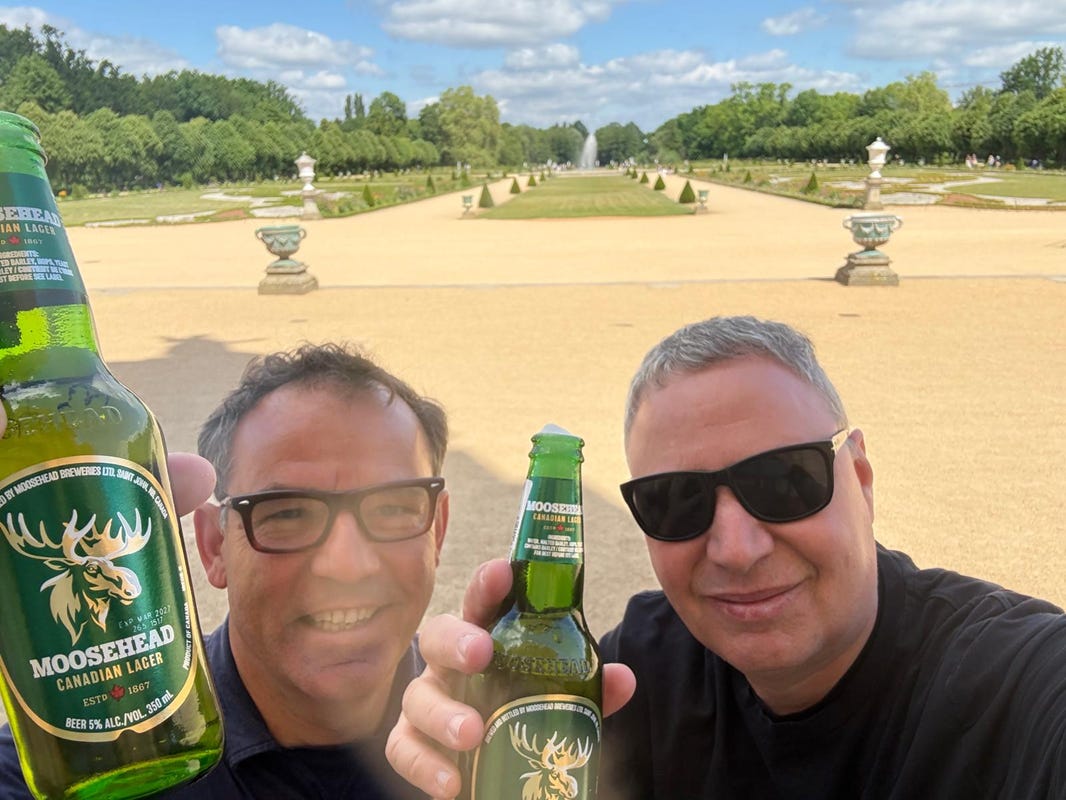
Ulli and I met about 45 years ago when he was a high school exchange student in my corner of Philadelphia. He was amazed to learn of my provenance. “You know, we have not many Jews left in Germany,” he said then.
Yes, he did.
Absurdity is one of my hobbies, so I have loved him ever since.
Can there be redemption always, no matter what? It is not mine to give. But as I observe the cycle of life, and the movements of karma hither and yon across the globe, I lean toward saying yes. I think so. I definitely think so. But also I am not sure. None of us really know what judgment awaits.
Beautiful post. What awaits indeed. A lovely description of your visit and reflections. Not one mention of America being in 1935 today.
I hope germany's demons are in the past but with Elon musk et al openly providing support to the new German Nazis who are growing in parliament it’s hard to say. Fascism has gone global and as America falls to it the danger rises exponentially..
A super piece, thanks.
Went first to Berlin not too long after your first trip. Expected and quite hoped to hate it and was looking for trouble. It was fabulous and went back several times subsequently.
Don't wish to bore on about how bad it is here but I don't share your optimism of the United Kingdom's capacity (and intent) to repair our armed services, or anything else for that matter. We're in a real mess with plenty more to come.