
Should the US Push for Democracy in Venezuela?
A debate with conservative pundit Daniel DePetris

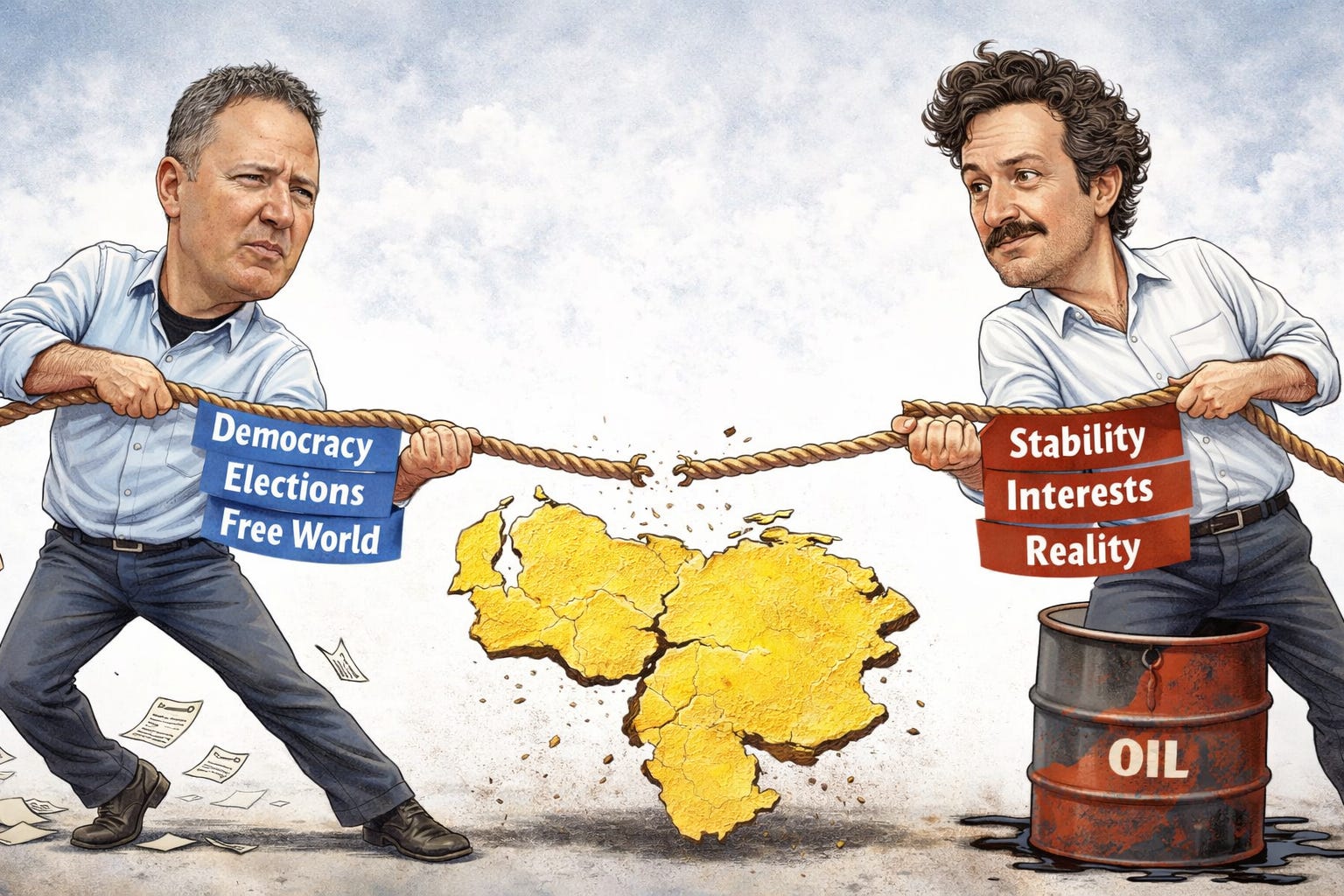
After decades of economic collapse, political repression, and mass displacement, the United States last month oversaw the removal of Nicolás Maduro from power in Venezuela — a dramatic intervention that was widely framed, at least initially, as a reset for Venezuelan democracy. For years Hugo Chávez and then Maduro had destroyed institutions, undermined elections, and presided over a catastrophe that drove millions into exile. In that context, the US move was greeted by many as a potentialopportunity to restore electoral integrity and the pluralism the country once enjoyed. Think again.
Within weeks — some would say days — it became clear that the transition was neither clean nor straightforward. Instead of installing María Corina Machado — the opposition leader who won last year’s election before it was stolen and who has a demonstrable democratic mandate — Trump signaled an openness to backing Maduro’s own deputy, Delcy Rodríguez, so long as she follows a policy script acceptable in Washington. For critics of this approach, that amounts to propping up a “decapitated” Chavista regime that still holds the levers of power merely because it is ready to cooperate on oil and geopolitical alignment.
The result is not a bright dawn of democratic renewal, but a kind of transactional realpolitik in which regime type matters less than predictable access to petroleum and strategic utility. If this hold true, it means Trump as the chief mafioso.
This is a time of emergency. To support the defense of discourse, decency and reason, consider unlocking full access to Ask Questions Later by upgrading to a Paid Subscription
This has left many — from Venezuelan activists to US foreign policy traditionalists — deeply disappointed. To them, allowing a faction of the old order to persist in power looks like endorsement of the very authoritarianism the intervention was supposed to end. The farce reached a surreal note when Machado publicly handed over her Nobel Prize to Trump in an overture that was widely derided as absurd theatre. It is all just deeply, dispiritingly sad. Yet is is.
So, a month after the United States deposed Venezuelan President Nicolás Maduro, I debated my occasional sparring partner Daniel DePetris on the question of whether Venezuela will see democracy anytime soon. What can the Trump administration do to move Venezuela in this direction? Or was the US intervention about oil all along?
Dan Perry: Nation building has a troubled history, littered with hubris and failure, and democracy cannot just be imposed or air-dropped by foreign power. But Venezuela is not a blank slate. It does have a democratic history—imperfect, fragile, yet genuine. For decades it held competitive elections, alternated power, sustained a pluralistic press and cultivated civic expectations about accountability. Encouraging democracy there is not inventing something alien. Sadly, it doesn’t look like Trump cares at all. His National Security Strategy explicitly disdains democracy promotion, and he seems happy to keep the Chavista mafia in power as long as it provides access to oil. Disgraceful.
Daniel R. DePetris: The Trump administration’s foray into Venezuela was never about overthrowing an autocracy and transitioning the South American country into a democracy. For President Trump, democracy promotion and nation building are things that should be avoided, not endorsed. Both ambitions are resource-intensive, time-consuming and in the end hardly guaranteed to succeed. Instead, Trump’s policy toward Venezuela can best be described as a return to old-fashioned imperialism, in which the U.S. leverages threats of military force, the carrot of diplomatic engagement and control over the Venezuelan oil industry to pressure the interim authorities in Caracas to cater to U.S. policy demands. The degree to which Maduro’s successor, Delcy Rodriguez, follows Trump’s script will determine whether Trump uses a similar playbook against other adversaries in the Western Hemisphere, such as Cuba or Nicaragua.
Perry: Opposing democracy promotion isn’t realism but nihilism. Democracies aren’t perfect, but they are consistently less murderous, less corrupt and more stable than gangster regimes. To claim indifference to regime type is to normalize repression as long as deals are struck. This applies too with Iran—Trump encouraged protestors, warned the regime not to massacre them (which it did) and now signals that he may ignore them and try to reach some deal normalizing the regime. This moral incoherence has lethal consequences. Are you sure you no longer want America to lead the free world?
DePetris: Define “free world.” I think that term is one of the most persistent myths out there. Is Saudi Arabia free? What about the United Arab Emirates? Or Egypt and El Salvador? The United States holds strategic relationships with plenty of awful governments around the world because the powers that be have concluded that doing so advances some kind of U.S. national interest. This is likely where we’re headed with respect to Venezuela. Chavismo still holds the levers of power, and despite the fairly cosmetic changes enacted by the interim authorities, a repressive state structure is still very much calling the shots there. You can either accept this reality and try to work with it, or you can seek to turn this structure into a democratic utopia, which is a great way of undermining the broader diplomatic opening that Caracas is currently interested in.
Perry: The free world means democracies, led by a superpower that can still manage pragmatic ties with non-democracies while nudging them toward less repression. In Venezuela, Hugo Chávez and Nicolás Maduro wrecked the country, driving a quarter of its people into exile. Ignoring a stolen election and failing to back María Corina Machado’s victory abandons decency for no strategic gain. Restoring democracy would serve U.S. interests and stabilize the hemisphere in the long term. Projecting, as Trump does, that there’s nothing wrong with repression does a disservice to everything a patriot should love about America.
DePetris: That’s all well and good, but we need to acknowledge just how hard the task of restoring democracy will truly be. Yes, Machado’s political movement won an overwhelming victory over Maduro during last year’s presidential election. But for the United States, it’s not as simple as accepting those results, putting Machado on a plane and sending her to Caracas to take over the political system. Frankly put, the people who matter the most in this situation are those with the guns and the ministerial portfolios, and none of them have an interest in diminishing their own power and privileges—however ill-gotten they may be. Outside of a Nobel prize that she gave to Trump in a pathetic display of self-subjugation, Machado doesn’t have much leverage inside Venezuela.
Perry: So what? I still wouldn’t legitimize a stolen election or settle for domesticating the existing mafia. We can be better than that. I’ve lived all over the world and have met people who assume the worst duplicity and cynicism of America. It’s sad to see an administration validate that, and it is funny (or perhaps tragicomic) to see how it is centrist liberals who seem to lament it more than many conservatives!
DePetris: Again, it shouldn’t be the United States who does “better than that.” It’s up to the Venezuelans themselves. As far as Iran is concerned, nobody disputes the current regime in Tehran is horrible. And yet at the same time, nobody can say with a straight face who or what would take over in the hypothetical scenario of Khamenei being killed or overthrown. If you have an idea, please let me know. There is no organized Iranian opposition movement inside the country that can agree on anything, let alone what Iran should look like after the clerics are gone. The Islamic Revolutionary Guard Corps, not some Nelson Mandela-type figure, is most likely to take the reins. U.S. policymakers need to think about all of this, not be guided by emotional reactions and best-case assumptions.
Perry: Of course you’re right that we must avoid emotion and impulse. Sometimes, though, you choose the less bad option and roll the dice. I want the Islamic Republic gone, as do most Iranians, even if armed actors, likely including at least part of the Revolutionary Guards, seize power. There’s no way the Islamic Republic as constituted is the least bad option. The same is true in Venezuela, where we need to at least nudge democratic change. What I reject is a version of America that actually prefers kleptocratic dictators, murderous authoritarians or jihadist theocrats over imperfect change.
DePetris: My recommendation for Venezuela is simple: work with the government you have. That’s essentially what the Trump administration is doing now, albeit with a high degree of coercion attached. The only other option would be to instigate a return to democratic rule. That can be a long-term U.S. objective, but shouldn’t be guiding the policy right now, if only because Chavismo is in no way, shape or form going to cooperate in such a scheme. If anything, they are likely to resist it, creating even more problems for the United States at a time when it’s trying to push Venezuela into a friendlier direction geopolitically. This subject isn’t going to go away any time soon.
Daniel R. DePetris is a fellow at Defense Priorities and a syndicated foreign affairs columnist at the Chicago Tribune.
I hardly think Felon Trump is working with the Venezuelan government, or any country’s government. And we are stuck with him until he is removed, by death or impeachment. For this reason, I feel we should conserve our energy to remove him first from office and then see what his successor will do. That brick wall is not changing no matter how hard our head strikes the wall. We cannot do anything to help the Venezuelan people, more’s the pity (to use a quaint term.)
The United States is such the glowing, sterling exemplar of Democracy.