
The Ultimate Iran War Briefing
On the three endgames, Hormuz, NATO tensions, Kent resignation, China, Russia and Ukraine

From the outset, there were mainly three plausible trajectories for the war in Iran. Everything now unfolding, from the decapitation strikes in Iran to the blocking of the Strait of Hormuz to the global political agitations and the fissures in NATO, are determining which in the end will come to pass.
The first is the fall of the Iranian regime. It could come through internal fracture, or a military coup, or civil war, or massive street unrest. If there’s no resulting chaos, this would be greeted with cheers across much of the world. Iranians, Arabs and Israelis have the most to gain, but even the cautious Europeans would be pleased (except about the boost to Trump). Russia, China, and North Korea would be set back.
The second scenario is that the regime survives, but in a weakened, chastened form. Under sufficient pressure — military, economic, internal, with remaining leaders perhaps terrified — it could be driven to seek terms. Those would have to be uncompromising on three fronts: a verifiable renunciation of nuclear weapons ambitions, an end to long-range ballistic missile development, and a cessation of support for proxy militias across the region. These are the minimum conditions for regional stability. The question is whether a regime built on ideological defiance and religious extremism can accept constraints (and whether the West, faced with the opportunity, would have the discipline to insist on them).
The third scenario is for many the most troubling — and, at the moment, possibly the most plausible. The war becomes too costly, too destabilizing, too politically difficult. And eventually, Trump declares victory and steps back, pulling Netanyahu with him. It would not be hard to construct the narrative: Iran’s capabilities degraded, its leadership decimated, its infrastructure battered. The regime, it could be said, has been “taught a lesson.” There is just enough truth in that to make it politically viable. But the deeper reality would be different. The regime’s survival and non-capitulation would be seen as a victory by many, the United States would be humiliated, and the Iranian opposition perhaps demoralized.
Please read on as the paywall has been removed — but consider an upgrade to a Paid Subscription. You will be enabling independent reportage and commentary, joining a growing new community, and unlocking access to all content.
That is why Hormuz has become the center of gravity in this conflict. The real contest is whether Iran can sustain enough disruption to the world economy that it basically outlasts its foes, despite the vast military advantage. The more time passes, the more this favors Tehran. The United States and its partners are operating on one clock – that of rational people. The Iranian regime is operating on a different clock — fanatics who do not care about their people, their views, their preferences and their suffering.
One must assume, though, that inside regime circles there is intense debate.
This week brought more high-level assassinations, most meaningfully of security chief Ali Larijani, who some considered the regime’s top official after the assasinated Supreme Leader Ali Khamenei — as well as the heads of intelligence and the Basij (the massacre police).
Each of these can be replaced, as I explained on I24 (above) — but I consider that a message to the military and to the remaining leaders. The loss of such senior leadership, including figures at the very top of the system, cannot but trigger some reassessment. There are likely voices arguing for de-escalation, even capitulation. But for now, the regime is making a calculated bet: that Hormuz will break the coalition before internal pressures break them. It would be very costly to the free world – who is, absurdly and damagingly, current led by Trump – for Iran to win this bet.
Failing to Foresee the Obvious
According to detailed reporting in The Wall Street Journal, was explicitly warned, repeatedly, that Iran’s most powerful response to an attack would be to disrupt or close the Strait of Hormuz. It seems Trump believed Iran would capitulate before taking that step — and even more astonishingly, that he did not expect significant attacks on US allies in the Gulf. If accurate, this is not merely a miscalculation. It is a failure so basic, so detached from the accumulated knowledge of American strategy, that it is malpractice.
Iran has signaled for years, in doctrine, exercises, and rhetoric, that Hormuz is its ultimate lever. Every serious analyst, every military planner, every diplomat who has worked the file understands this. The idea that such a determined, murderous and fanatical regime would simply absorb strikes on its leadership, its military infrastructure, and its territory without reaching for its one asymmetric advantage was basically absurd.
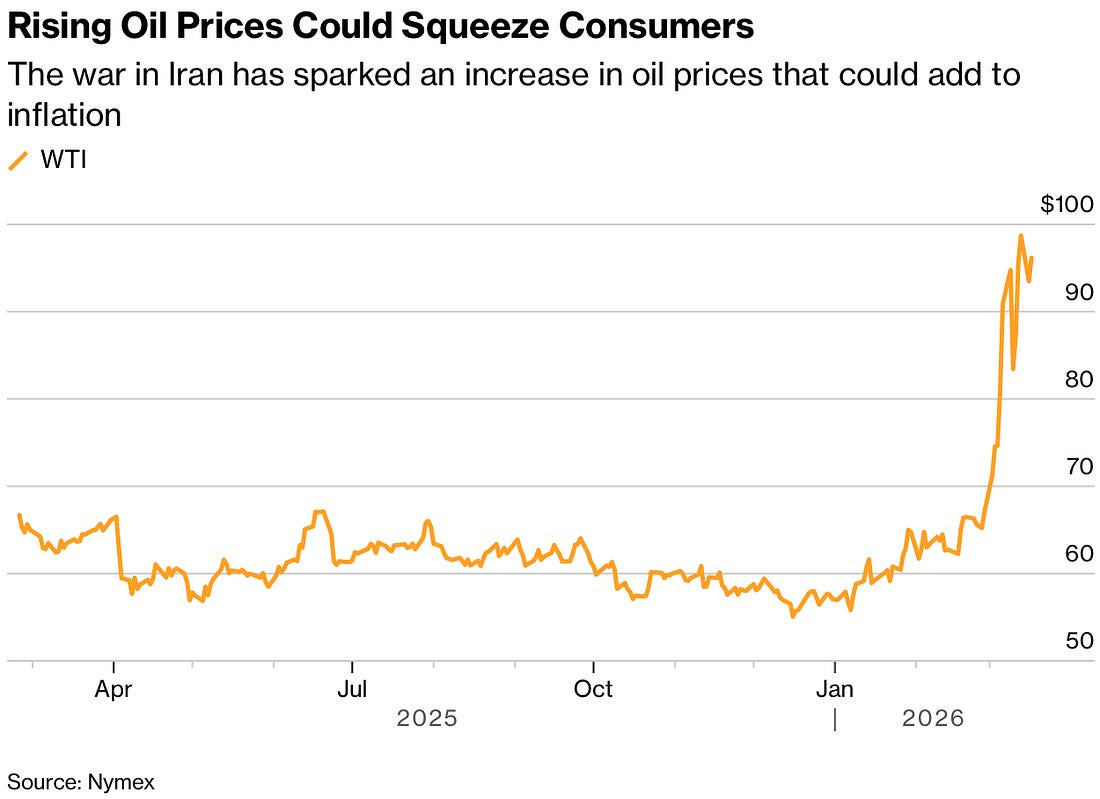
We are now living with the consequences of that hope. Tankers are being harassed, insurance markets are rattled, energy prices are spiking, and the global economy is beginning to absorb a shock that will create huge pressures for either capitulation – Option Three described above – or a radical solution.
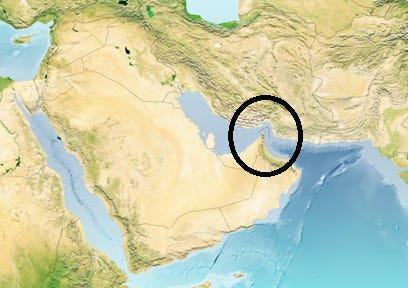
Reopening Hormuz is not simply a matter of destroying targets, but requires sustained control of a dense, contested maritime environment against an adversary that only needs to succeed intermittently to impose strategic costs. Every mine, drone, and missile fired from the coast reinforces the reality that the United States is now playing defense in the most important waterway on earth.
If air and naval power prove insufficient to secure the strait, the logic of escalation becomes difficult to avoid. The map points in one direction: the Iranian coastline adjacent to Hormuz. Securing it would mean boots on the ground — limited, perhaps at first, but with all the risks of expansion, entanglement, and time.
And once that threshold is crossed, the character of the war changes completely. This is no longer a campaign measured in weeks. It becomes something open-ended, with a rising human toll and a massive political impact back home. A serious qaugmire looms.
So what, precisely, was ever the plan for Hormuz? What assumptions underpinned the decision to proceed? And how did the most predictable Iranian response become, apparently, a surprise? The American public — and America’s allies — deserve clear answers.
Keeping Your Friends Distant
What has followed is truly tragicomic: Trump is now frustrated that NATO is refusing to step in and help clean up the crisis. Trump called allies “foolish” for declining to assist in securing the Strait of Hormuz — even as he insisted, with his customary coherence level, that the US doesn’t need them.
This is the moment to remember that most European of words: schadenfreude. Because for the past several years, Trump has made a point of undermining the very alliance he now expects to rally behind him – and disrespecting the Europeans in general. He has derided NATO as obsolete, questioned its core premise, and treated alliances not as strategic assets but as transactional burdens.
His administration’s rhetoric (and December National Security Strategy) de-emphasized democracy as a guiding principle of US foreign policy. He has threatened allies, including floating the extraordinary notion of taking Greenland from Denmark, a NATO ally, by force (!). His envoys, including even the mild-mannered Marco Rubio, have gone to European forums lecturing partners about some supposed civilizational decline, basically because they have let in too many migrants.
And in what was both a betrayal and an indult to everyone’s intelligence, He imposed tariffs on every country on Earth, including America’s European allies. This messed up their economies and introduced huge inefficiencies and also amounted to a tax on the US consumer, who pays for the tariffs – and on this issue he has lied from dawn to dusk. This drove inflation at home and forced the Europeans to seek new freer-trade deals with India and Latin America, while Trump peddled nonsense about hundreds of billions being paid by foreigners now, finally, respectful of America.
So this week we saw a measure of that respect. Every country in the world, basically, has a massive interest in the Hormuz being reopened. None heeded Trump’s call for assistance. Clearly, they would rather see Trump twisting in the wind.
Trump now threatens again to leave NATO, but someone should tell him that NATO’s Article Five can only be invoked when a member nation was attacked. And it might have helped to have shown NATO the respect of even a minimal consultation before. When this is over, the real diplomatic repair job is within NATO. The United States owes its allies an apology.
The Clerk, Kent
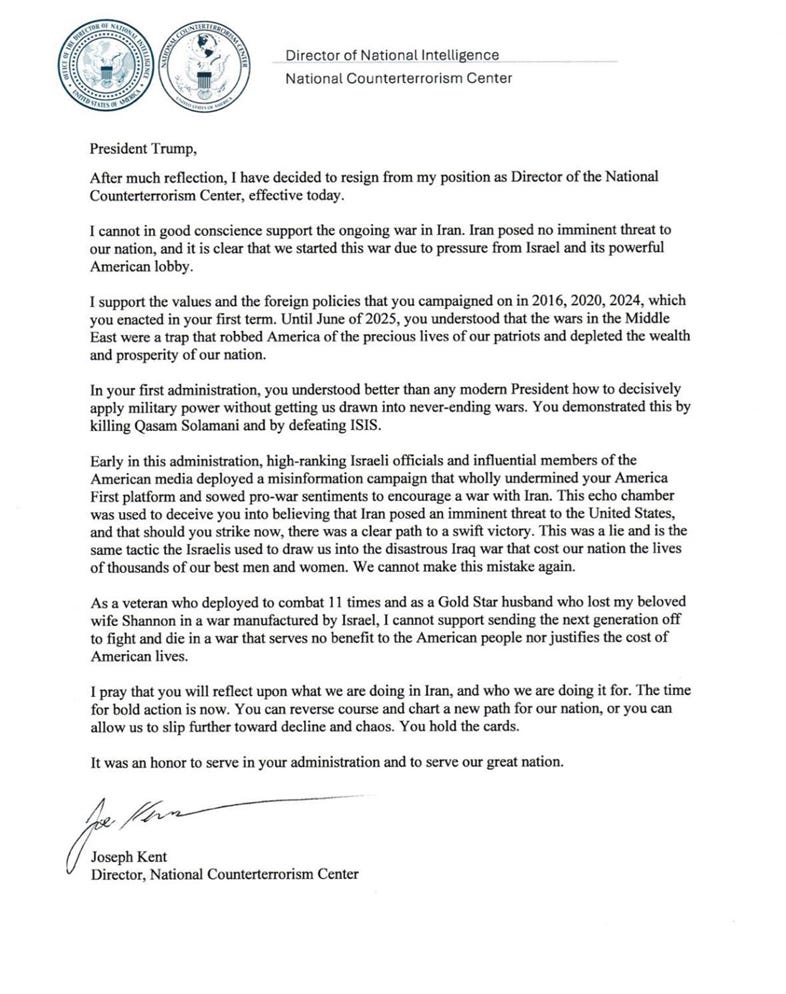
Joe Kent, a senior intelligence official appointed by Trump, this week resigned in protest, declaring that Iran posed no imminent threat to the United States and — more explosively — that the war was driven by Israeli pressure. Kent has long flirted with conspiratorial thinking and unsavory figures on the fringes of the MAGA movement. His resignation letter veered into territory that, at best, is reckless and, at worst, echoes strains of anti-Semitic tropes that have no place in serious discourse.
And yet, the broader claim he is gesturing toward cannot simply be dismissed out of hand. The idea that Netanyahu, who strongly favored confrontation with Iran, ran circles around Trump is plausible. After all, Netanyahu is infinitely manipulative, constantly scheming and darkly brilliant, while I have no confidence Trump can find Hormuz on a map.
Kent clearly represents parts of the MAGA ecosystem drifting into an even darker space, where criticism of Israeli policy bleeds into conspiracism about Jewish influence. If the war ends badly, the narrative that “Trump was dragged into this by Netanyahu” will not stay confined to the fringes but migrate inward. It will become, for many, the explanation.
Tulsi Gabbard – Trump’s bizarro ex-Democrat national security chieftain – should expect some serious questioning about all of this in congressional hearings today. She will be asked, bluntly, what intelligence justified this war — and whether the administration’s repeated claims of an “imminent threat” were ever grounded in reality. Gabbard will probably argue that it is the president ultimately determines what constitutes a threat. Oh, boy.
The Servant of the People
One of the strangest and potentially most consequential side effects of this war is that it may yet force Trump to notice, finally, who is actually on which side. According to reports, Russia has been sharing satellite imagery, targeting help, and upgraded drone know-how with Iran to improve Tehran’s ability to strike US and allied assets in the region. The Kremlin denies it, but even Trump himself has already said Putin may be helping Iran “a bit.”
So Russia is helping the other side in what is Trump’s most consequential geopolitical gamble. Moscow has every reason to do so: a prolonged Gulf conflict raises oil prices, strains US military inventories, distracts Washington from Europe, and complicates support for Ukraine. The Iran war has played to Russia’s advantage by drawing down air-defense resources that Ukraine needs and by boosting the price of oil, the lifeblood of the Russian economy.
And yet there is irony here. By backing Iran, Putin is handing Volodymyr Zelensky his best opening with Trump in months. Trump has spent much of his presidency treating Ukraine as a burden, Zelensky as an irritant, and Putin as someone to be indulged, or at least endlessly rationalized. Trump calls Zelensky, not Putin, the dictator, and suggests Ukraine, not Russia, started the war. He wants Ukraine to capitulate to Russia’s demands and has ended direct aid – a massive betrayal that the Europeans have neutralized.
No one knows what Putin has on Trump – but even Trump cannot fail to notice that Ukraine, unlike Russia, is plainly on his side, as opposed to the side of Iran, which has provided Russia with attack drones.
Ukraine has lived for years under the assault of these drones, and has developed exactly the expertise this moment requires. (Below, Zelensky explains this on I24.)
Reuters reported this week that Britain and Ukraine are now looking to market joint drone capabilities abroad, and that Ukrainian personnel and technology are already being deployed in the Middle East as part of broader defense cooperation. Ukraine is becoming a security exporter.
The Year of the Fire Horse
China should, in theory, have a massive interest in helping keep the Strait of Hormuz open, simply because a huge majority of its own oil imports depends on it. But as the China Daily notes, Beijing has spent years building strategic petroleum reserves and diversifying supply routes, including pipelines from Russia and Kazakhstan, which gives it a significant buffer in the event of a major disruption. The estimate is that China could withstand a total cutoff of Middle Eastern crude for roughly six months.
That reserve cushion may give Beijing the luxury of staying cautious while Washington absorbs the political humiliation, especially as some China-bound shipments from Iran itself have continued moving even as broader traffic has seized up.
There is a deeper, more dangerous layer to all of this—one that goes beyond Iran, beyond NATO, even beyond the Middle East. It has to do with the rules of the game themselves.
What Trump is effectively suggesting — through action and doctrine — is that great powers can do what they want in their perceived spheres of influence. Venezuela, Greenland, Iran, even the casual talk of taking on Cuba next — all point in the same direction. Not international law, not alliance structures, not even consistent strategic logic, but raw capability as justification. It helps if there’s an argument – yes, the regimes in Iran, Cuba and Venezuela are all horrendous – but this is nonetheless a departure from the postwar order.
And it is an invitation. Chinese officials have already condemned US actions as violations of sovereignty, even as analysts note that such moves risk emboldening China’s posture on Taiwan by normalizing unilateral force . More importantly, it provides something even more valuable than precedent: narrative cover.
China has never lacked a justification for Taiwan. It already considers the island an internal matter. But what it has often lacked is a clean way to frame action to the world in a way that blunts Western criticism. When the United States begins to blur the line between self-defense and opportunistic intervention, that is a gift to China. You did it. Why can’t we?
Trump is reaping what he sowed but will not be capable of understanding. What is perplexing is the way America's inbuilt checks and balances just aren't working. A bully has to be confronted wthout fear.
The incompetents around the President clearly did not provide adequate advice but how come the system, which is not (yet) a dictatorship, allowed one man to ignore any advice he disliked and proceed recklessly when even the simple fact that Congressional approval had not been sought or given was enough to halt the process from day one?
The lie about an immediate threat - rather than just an immediate opportunity for assassinations - recalls the propaganda about WMD (Tony Blair and Bush the father) prior to the attack on Iraq.
But Bush didn't embark without painstakingly lining up a broad coalition of nations which excluded Israel for maximum cohesion.
That letter by Joe Kent amounts to a devastating indictment of Israeli intentions which will likely be widely believed and as hard to refute as an accusation of harassment with no witnesses.
Israel's current political leadership is no less incompetent than that of the US: every word they say contributes to the rising antisemitism abroad and their every action reinforces age-old prejudices. The army is admired and even feared but force alone cannot do the job, as Trump is finding out.
We have come to a pretty pass - and I don't mean Hormuz.
Dan, I'd like to send your own words back to you with a minor change. "The question is whether a regime built on ideological defiance and religious extremism can accept constraints (and whether the American people, faced with the opportunity, would have the discipline to insist on them)." So far, we have not.
I live in west Michigan which is as MAGA as it gets. White Christian Nationalism is in the air I breathe every day. These are people who believe in Trump because he is paving the way for the return of their savior. War, disease, poverty, degradation of the environment are all GOOD! Lying, cheating and stealing are OK as long as it is in the service of that heavenly goal. Some will cheerlead for nuking Tehran. How's that for "Some big surprise" ending? I would not be sanguine about assuming these people will act rationally in a time of crisis.