
The Washington Post Disaster is an Indictment of Both Publishers and Society
It’s too easy to blame journalists. The crisis in the news media stems from publishers who chased reinvention instead of excellence - and because too many people just don't care.

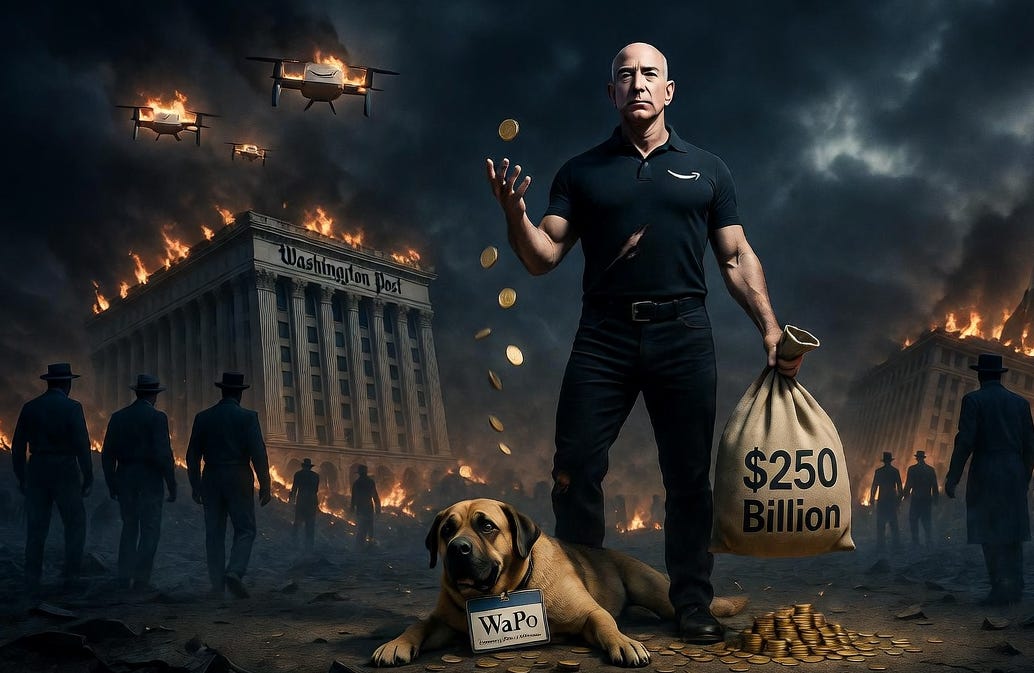
The shocking diminishment of the Washington Post, which has just announced it is cutting a third of its staff, is not just another story of a great paper succumbing to algorithms, social media and the march to idiocracy. In their zeal to be seen as fair and evenhanded, journalists tend to accept the common criticism that they failed to adapt — that, basically, they didn’t produce enough viral TikTok videos.
There’s some truth to that, but the main problem lies elsewhere. This disaster is an indictment of the business side of journalism: its inability to understand what remaining readers value, its mistaking novelty for strategy, its cowardice about insisting the product has economic value, its failure to collaborate as an industry, and its refusal to get out of the way of the product it exists to serve.
Of course, there is also a failure of society. We faced a test over the past thirty years: Did we educate ourselves to value truth (and civility and justice and progress)? Do we care enough to pay enough to keep the machinery of reliable information going — the way we do for beer and sneakers? And guns in dumb places and guaranteed healthcare in smarter ones? Turns out that we did not.
This is a time of emergency. To support the defense of decency and reason, consider unlocking full access to Ask Questions Later by upgrading to a Paid Subscription
To understand the collapse of the paper that once exposed the full dimensions of the Watergate scandal, you have to zoom out — and then zoom back in. Since roughly 2000, American media has been living through a slow-motion trauma. Print advertising collapsed as Craigslist and Google stripped away classifieds. Display ads migrated to platforms that offered targeting, scale, and metrics newsrooms could not match. Social media then rewired distribution, training publishers to chase traffic rather than loyalty. Each phase came with a promise that technology would save journalism if only it adapted fast enough.
What followed instead was a managerial culture obsessed with pivots: pivot to video, pivot to social, pivot to newsletters, pivot to creators, pivot to AI. Every pivot carried a cost, usually paid by reporters. McKinsey types pushed change as a panacea. News organizations began acting as if the core product — original reporting and authoritative analysis presented with some style — were less important that format, packaging, or distribution.
The result was a generation of media companies endlessly “innovating” around a shrinking journalistic core. At the Associated Press, we were self-flagellating over the “fire hose” (too many stories) and the “mushy middle” (again, too many stories) and setting up “test kitchens” for new ideas (read: snippets and short videos) in bureaus that didn’t have the staff left to cover the basic news.
The results were catastrophic before the Washington Post began imploding. In 2000, US newspapers took in $73 billion in print advertising revenue. By 2023, that figure had collapsed to just $6 billion—a 92 percent plunge. In 2008, American newspapers employed about 71,000 newsroom staff. By 2020, only 31,000 remained. There were now news deserts all over the US and other countries, but at least there was some hope that major media brands would thrive.
Into this landscape stepped Amazon billionaire Jeff Bezos, when he bought the Washington Post for $250 million in 2013. At first, it looked like a rescue. Bezos promised patience, independence, and investment. And for several years, he delivered. The Post hired aggressively, expanded foreign coverage, and rode the Donald Trump era to surging subscriptions and influence. Bezos tolerated the “Democracy Dies in Darkness” tagline after Trump’s first election win, to his credit. But there followed a series of terrible mistakes.
Since we don’t want to suffer the same fate, the rest of this article is for Paid Subscribers. To continue reading please upgrade. It costs the same monthly as a pint of beer!
