
There Is No Gaza Solution Without the Palestinian Authority
Israel’s refusal to work with the PA has prolonged Hamas rule. It looks like Trump’s Gaza plan may finally bring that foolishness to an end.

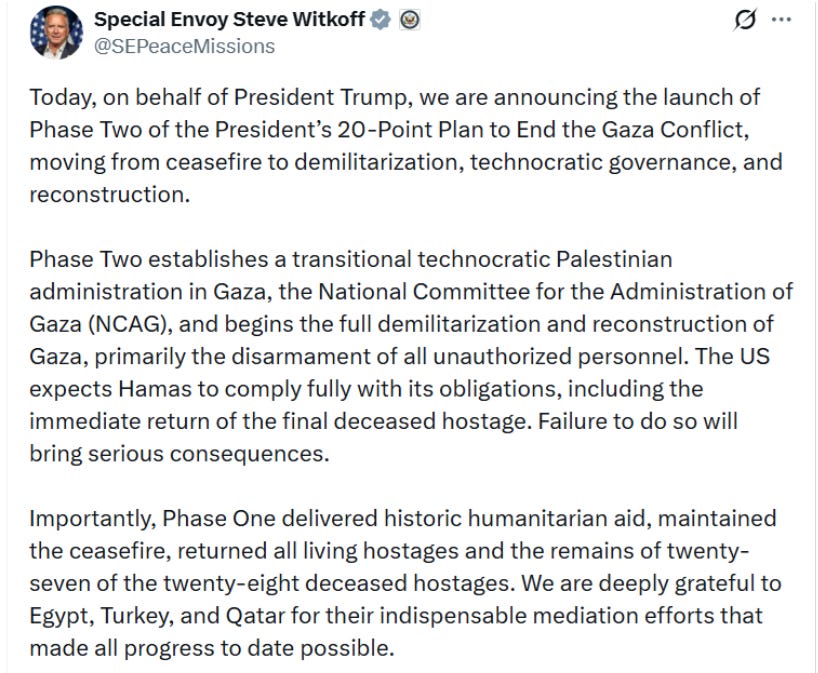
The launch of Phase II of the Trump administration’s Gaza plan, with the creation of a transitional Palestinian technocratic authority, marks an undeclared but important rupture with recent Israeli policy. A governing structure tied unmistakably to the Palestinian Authority is being assembled under U.S. sponsorship, endorsed by the PA, and tacitly accepted by Israel.
This collapses a fiction Israel has sustained for years: that Gaza can be stabilized without the Palestinian Authority, that the PA is no better than Hamas, and, for some nationalists, even that Palestinian governance itself is illegitimate. Reality has finally prevailed, and that reality is that the PA, flawed though it is, remains the only Palestinian political body capable of replacing Hamas in Gaza.
To support the defense of democracy, reason, and truth, consider unlocking full access to Ask Questions Later by upgrading to a Paid Subscription
Claiming otherwise is ignorance or deception – yet Benjamin Netanyahu kept at it even after the September cease-fire imposed by President Trump. Hamas has since reasserted control over large parts of Gaza, including most of its two-million-plus population. Militarily weakened, it survived politically because Israel still refused to empower any viable Palestinian alternative.
It’s not exactly new. Hamas was for three decades a strange but useful adversary for Netanyahu. Its existence sustained permanent emergency and created despair about the chances for peace that he spun into political capital. Indeed, as long as it rules Gaza, its very presence constitutes an emergency narrative that Netanyahu can use to delay the accountability over his responsibility for Oct. 7: Wartime is no time for politics.
That logic has brought Israel to the brink, and public anger is at a boil. Envoy Steve Witkoff’s tweet Wednesday gives millions a hope for something better.
It might work, and it might not. But the bigger picture is that this is where we are: The coming year may be the last chance to steer the Zionist project away from permanent war, international isolation, and internal decay. Israel’s next election will determine whether Zionism remains a viable moral and political framework or becomes the creed of a brittle, embattled society.
Of course, Israel has deep internal problems, including the disengagement of large parts of its population from the shared civic project. But the pivot point right now is resolving the nightmare of Gaza. Here, Netanyahu’s government did everything possible to delay resolution. “There is no difference between the PA and Hamas” became a mantra.
No serious professional believed this. The PA coordinates with Israel at enormous political cost in the West Bank, where its security forces arrest militants and dismantle cells. To equate that with Hamas — a theocratic militia that massacres civilians and rejects coexistence on principle — was outrageous and self-defeating.
Yet it was a feature and not a bug, serving a clear purpose: Blocking any Palestinian political framework that could force Israel to confront the need for separation from the Palestinians, real borders, and eventual Palestinian statehood. Hamas was convenient for Israel’s nationalists, its very existence justified endless war, emergency, and postponement. Hamas was a manageable enemy by being so vile. The Palestinian Authority, by contrast, was a dangerous one because it represented a measure of pragmatism.
That is why Israel tolerated Hamas rule in Gaza until October 7. It is why Netanyahu authorized Qatar sending Hamas’ Gaza authorities billions of dollars in recent years.
The technocratic committee being formed under Phase II is formally nonpartisan, but its personnel and legitimacy are PA-derived. Ali Shaath, a former PA deputy minister, is among its leading figures. Others come from the same institutional ecosystem – there is simply no other reservoir of Palestinian administrative experience. The PA has publicly endorsed the framework. So what is emerging is not a rival authority but an extension.
What must follow is pressure on Hamas to surrender its weapons in Gaza, backed by an international stabilization force. Disarmament will not happen for Israel or the United States. It might happen if the weapons are handed to Palestinians. The only workable model is Palestinian Authority security forces (as the new technocratic government lacks a security arm) operating with international backing and coordination with Israel and the new Gaza administration. Hamas’s senior leadership should probably be allowed to exit into exile.
To build a Palestinian consensus in this direction, regional powers — Qatar, Egypt, Saudi Arabia, the UAE, and Turkey — must make reconstruction conditional on disarmament. The choice must be unmistakable: real recovery without any trace of a Hamas militia – or years in tent cities. Moreover, areas under the new authority must visibly improve. Housing, electricity, water, employment, and movement must return in ways Palestinians can measure. The comparison with Hamas rule must be obvious.
Israel, for its part, must also meet its own obligations under the Trump plan. That means chiefly that it should declare clearly that once Gaza is stabilized, it is prepared to enter negotiations toward a Palestinian state, with final borders to be determined later. Israel can openly state its intention to retain major settlement blocs and seek long-term security arrangements in the Jordan Valley. It should also affirm in principle its readiness to recognize a Palestinian state and guarantee access arrangements in Jerusalem. These statements would not resolve the conflict—but they would restore credibility.
Such a process with the PA can also be made conditional. As outlined in existing U.S. proposals, the Palestinian Authority would be required to undertake concrete reforms: overhauling educational materials that do not prepare Palestinian children for peace, and ending payments to the families of imprisoned militants. Senior PA officials have already signaled willingness to move on both fronts. These are achievable reforms — far more realistic than fantasies about Israeli-backed local proxies governing disconnected enclaves under permanent occupation.
The payoff would be immense: normalization with Saudi Arabia, broader reconciliation with the Arab and Muslim worlds, the gradual erosion of the global delegitimization campaign against Israel, and renewed international cooperation—especially in confronting Iran’s nuclear program, ballistic missiles, and regional militias. Zionism would once again be seen as a serious national project capable of difficult, mature decisions.
Little of this is likely happen under the current Israeli government.
That is the central truth of 2026: a change of leadership in Israel is not optional for anyone who wants a better future. The disaster of October 7 was the culmination of years of strategic failure, ideological paralysis, and the reckless empowerment of Hamas. This is what happens when complacent societies repeatedly elevate unfit leadership in the face of existential danger.
So in the coming election, every Israeli patriot must vote. Every Israeli in the United States and elsewhere should fly home to vote. Arab citizens, too, must decide whether abstention will help perpetuate a government that thrives on permanent conflict with their kin on the Palestinian side. It is existential.
Regarding your closing remarks about encouraging more Israeli Arabs to vote in the upcoming Israeli elections, it seems that you are hoping for greater Arab representation in the Knesset. Are you saying that you would like to see a secular Jewish coalition together with the Arab parties as preferable to an accommodation with the religious Jews?