May Days
A review of the month at AQL
May was an exceptionally busy month for us, and below you’ll find a roundup of some of our most widely read and discussed coverage.
But first, a request. We are now in striking distance of breaking into the top teמ of international Substacks, and growing this publication further depends largely on readers like you. If you subscribe for free, please consider upgrading to paid. If you already subscribe, consider gifting a one-year subscription to someone who would value serious independent journalism and commentary. And whether paid or free, one of the most helpful things you can do is simply forward this email to friends or colleagues who may appreciate our work.
Consider upgrading to a Paid Subscription to unlock access to all content including the Critical Conditions podcast
Independent media is increasingly where original reporting, analysis, and argument are finding room to thrive. Established outlets still matter enormously, and the world needs them. But the media landscape is changing rapidly, and reader-supported journalism is becoming an ever more important part of it. Thank you for reading, sharing, subscribing, and helping this project grow.
Here is our May roundup:
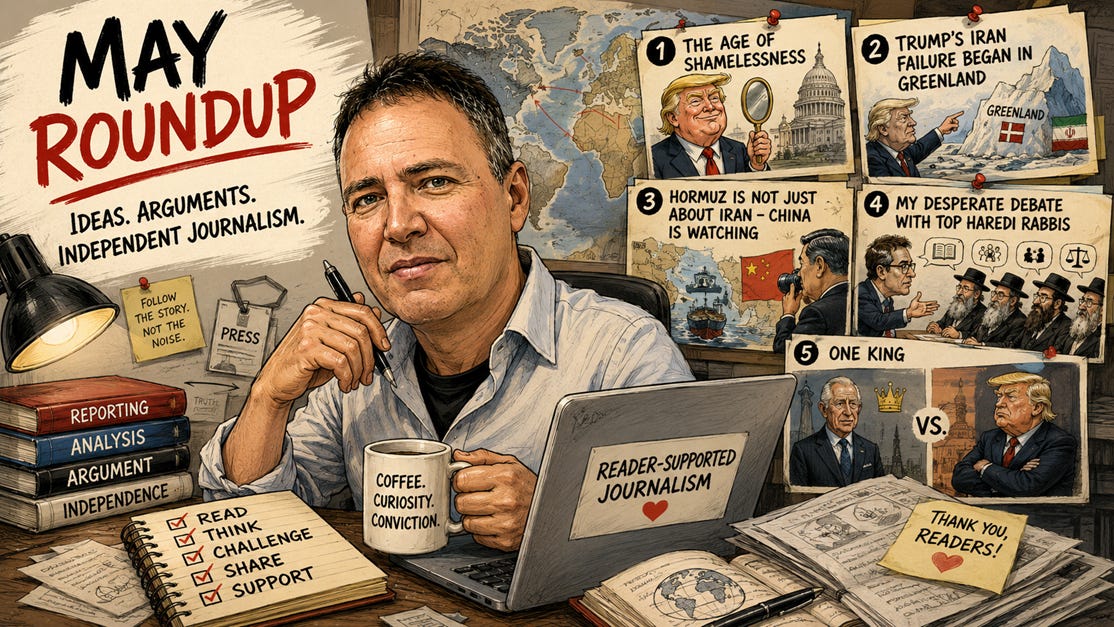
The Age of Shamelessness
We argued that corruption under Trump has reached unprecedented levels in American political life. Drawing on The Age of Innocence, we contrasted earlier eras of concealed corruption with today’s openly transactional politics, where influence, self-enrichment, and patronage are displayed without shame. We highlighted examples including a proposed $1.8 billion “Anti-Weaponization Fund,” Elon Musk’s close relationship with the administration, media consolidation tied to Trump allies, and Trump’s own extensive stock trading during periods of geopolitical turmoil. Scandals that once would have ended political careers are now normalized, with partisan loyalty overriding institutional accountability.
Trump’s Iran Failure Began in Greenland
We argued that Trump’s threats toward Greenland fatally damaged European trust in the United States at the precise moment Washington needed NATO unity against Iran. European governments viewed the rhetoric toward Denmark as proof that the administration no longer respected alliance norms, making them reluctant partners during the Strait of Hormuz crisis. Iran exploited those divisions, realizing the West lacked cohesion and resolve. The piece frames Greenland not as a sideshow, but as the symbolic rupture that fractured Western strategic credibility.
Hormuz Is Not Just About Iran - China Is Watching
In this geopolitical analysis, we argued that the Strait of Hormuz crisis is being closely studied by China as a test of Western resolve. Iran’s willingness to inflict economic pain through disruptions in global shipping demonstrates how authoritarian powers can exploit democratic societies’ aversion to economic hardship. Beijing may conclude that if the West hesitates to unite firmly against Iran, it would be even less willing to endure the massive economic costs of defending Taiwan against China.
My Desperate Debate with Top Haredi Rabbis
This essay reflects on intense discussions with senior Haredi rabbis about the future of Israeli society. Dan Perry portrays the conflict not merely as political, but as a profound civilizational struggle over education, modernity, military service, democracy, and the meaning of Jewish identity. He argues that Israel faces perhaps the deepest internal cultural war in the democratic world, with secular and ultra-Orthodox visions increasingly irreconcilable. The conversations reveal mutual fear and misunderstanding, while highlighting demographic trends that may fundamentally reshape the state. Perry warns that Israel’s liberal foundations could erode if compromise and reform remain impossible.
One King
We contrast King Charles III’s speech to the U.S. Congress with Trump’s approach to leadership, alliances, and democracy. Charles is cast as an unlikely but effective defender of the postwar liberal order — emphasizing NATO, Ukraine, democratic norms, and institutional continuity without directly attacking Trump. The piece uses passages from the speech to highlight opposing worldviews about alliances and global order. Ultimately, the essay becomes a broader defense of institutions, expertise, and constitutional stability against populist spectacle and political opportunism.
Romania Is Emerging as a Surprising Tech Power
Alison Mutler argues that Romania’s surprising sweep of the 2026 FIRST Tech Challenge World Championship in Houston reflects a deep and longstanding reservoir of technical talent rather than a fluke. Despite Romania’s reputation for corruption, weak infrastructure, and low R&D spending, the country has consistently produced outstanding engineers, mathematicians, and scientists through a rigorous educational tradition dating back to the communist era. Mutler traces how strong technical training survived institutional collapse, brain drain, and economic turmoil after 1989. She contends that Romania now occupies an increasingly important place in Europe’s tech landscape, illustrating how smaller nations can leverage human capital into strategic influence and technological relevance.
Getting Our Bearings
In this reflective essay, we explore how deeply maritime and archery metaphors shape the English language and, by extension, modern thought itself. Prompted by a conversation in London, we trace phrases like “learn the ropes,” “at sea,” “long shot,” and “hit the mark” back to England’s naval and military history. Britain’s seafaring culture forged a language built for precision, navigation, and survival, which later spread globally through empire and American dominance in technology, finance, and media. The essay ultimately becomes a meditation on how language silently structures perception, steering how people think, communicate, organize ideas, and understand the world around them.
Ghosts Over Berlin
Dan Perry reflects on Berlin’s transformation from a divided Cold War city to a vibrant, unified capital. Revisiting places he first saw in 1988, he recalls the stark contrast between communist East Berlin and prosperous West Berlin, and marvels that almost no trace of the Wall remains. Encounters with his longtime German friend Ulli spark reflections on German history, the Holocaust, national character, and Europe’s security challenges. Visits to memorials, museums, bars, and palaces reveal a city haunted by its past yet remarkably normal. The essay ultimately considers redemption, memory, friendship, and whether nations—and people — can transcend even their darkest histories.


You wrote many interesting articles this month, but unfortunately the most interesting (if something can be both sickening and interesting) thing I read was Heshy Grossman’s combative, self-righteous responses to non-Heredim in the comments to your article about the Heredi - secular divide in Israel. Even now, I remain optimistic that one day, a just and peaceful settlement between Israel and the Palestinians will be found, because it must be, and because the world demands it. Both sides will compromise, even though compromise will be painful. But there is no compromise in the Heredim, and much of the world will happily watch as they tear Israel apart.