The Longest Light
THE AQL JUNE ROUNDUP: Are we being parsimonious with the right things?

The month of the summer solstice has been busy at Ask Questions Later. War. Diplomacy. Iran. Ukraine. AI. Journalism. Democracy. Kosovo. Technology. Language. Podcasts. Essays. Guest contributors. Videos. Travel. Long-form analysis. If it felt like we’re publishing constantly, it's because we practically were.
Which brings us to the cartoon above. One character orders another $10 Coors Light. Another wants to bet on the races. A third is absorbed in social media, wearing bling and sporting tattoos. Yet somehow the one thing that’s become “really unaffordable” is paying a pittance for information and analysis.
We get it. Everyone is inundated with subscription requests, and we don’t want to become another publication that walls off every worthwhile article behind a paywall. That’s a deliberate choice. We want most of our work to remain available because good ideas shouldn’t be reserved only for those who can afford them. But that model only works if enough readers decide it’s worth supporting voluntarily.
If Ask Questions Later has become part of your intellectual diet — if you enjoy the essays, the conversations, the original arguments, and the willingness to challenge conventional wisdom — please consider becoming a paid subscriber. You’re not just buying access; you’re helping make the next month’s work possible. And if the subscription price is genuinely an obstacle, don’t disappear. Send us a private message. We’ll happily work something out. We’d much rather have you reading than lose you over a few dollars.
If you agree, click below.
Now, here’s the June roundup.
We boldly went where basically everyone did and gave Trump a failing scorecard in the Iran war, over the unforgiveable failure to anticipate and prepare for the closing of the Strait of Hormuz, which spawned a panic that begat capitulation; but we did it in our own particular idiom, which is to say detail and a pithy headline (“The Art of the Steal”). We also examined the forever war on Israel’s northern border — where, just when it seemed that there was no limit to nonsense, the US actually engineered a very significant agreement between Lebanon and Israel; it also constituted one of the greatest acts of courage by an Arab leadership that we have seen in some time.
On the Critical Conditions podcast Claire Berlinski and I we examined whether the Iran fiasco heralded the end of American power and Israelis’ shocked — shocked! — realization that Trump might not be a true friend. We also repeat-hosted Iranian opposition figure Nazenin Ansari, who was strangely optimistic — as well as (and now for something completely different!) UK politics insider Ben Judah for a talk on why Keir Starmer resigned.
Here are some of the specific highlights:
The March of Folly Comes to Hormuz

AQL argued that while the war against Iran may have been justified and initially successful militarily, it became a historic strategic blunder because the United States failed to prepare for Iran’s most obvious response: disrupting the Strait of Hormuz. Once Iran demonstrated its ability to disrupt global energy supplies through relatively inexpensive asymmetric tactics, it transformed military defeat into strategic leverage. Drawing comparisons to Napoleon’s invasion of Russia, Pearl Harbor, and the Iraq War, we concluded that this was one of the heights of strategic folly in modern history, worthy of a chapter in Barbara Tuchman’s book.
The EU Should Fasttrack Ukraine
Guest columnist Mihai Răzvan Ungureanu, the former prime minister and foreign minister of Romania, argued that the European Union should dramatically accelerate Ukraine’s accession process and make clear that Ukrainian membership is inevitable. He contends that Ukraine is no longer merely a candidate state waiting through bureaucratic procedures but has become central to Europe’s security, identity, and democratic future. Ukraine’s military experience, technological innovation, and sacrifices in resisting Russian aggression have transformed it into a producer of European security rather than simply a recipient of assistance. Ungureanu argues that fast-tracking membership would send a powerful message to both Putin and Trump that Europe remains committed to Ukraine’s future despite uncertainty about American support.
The War of the Worlds
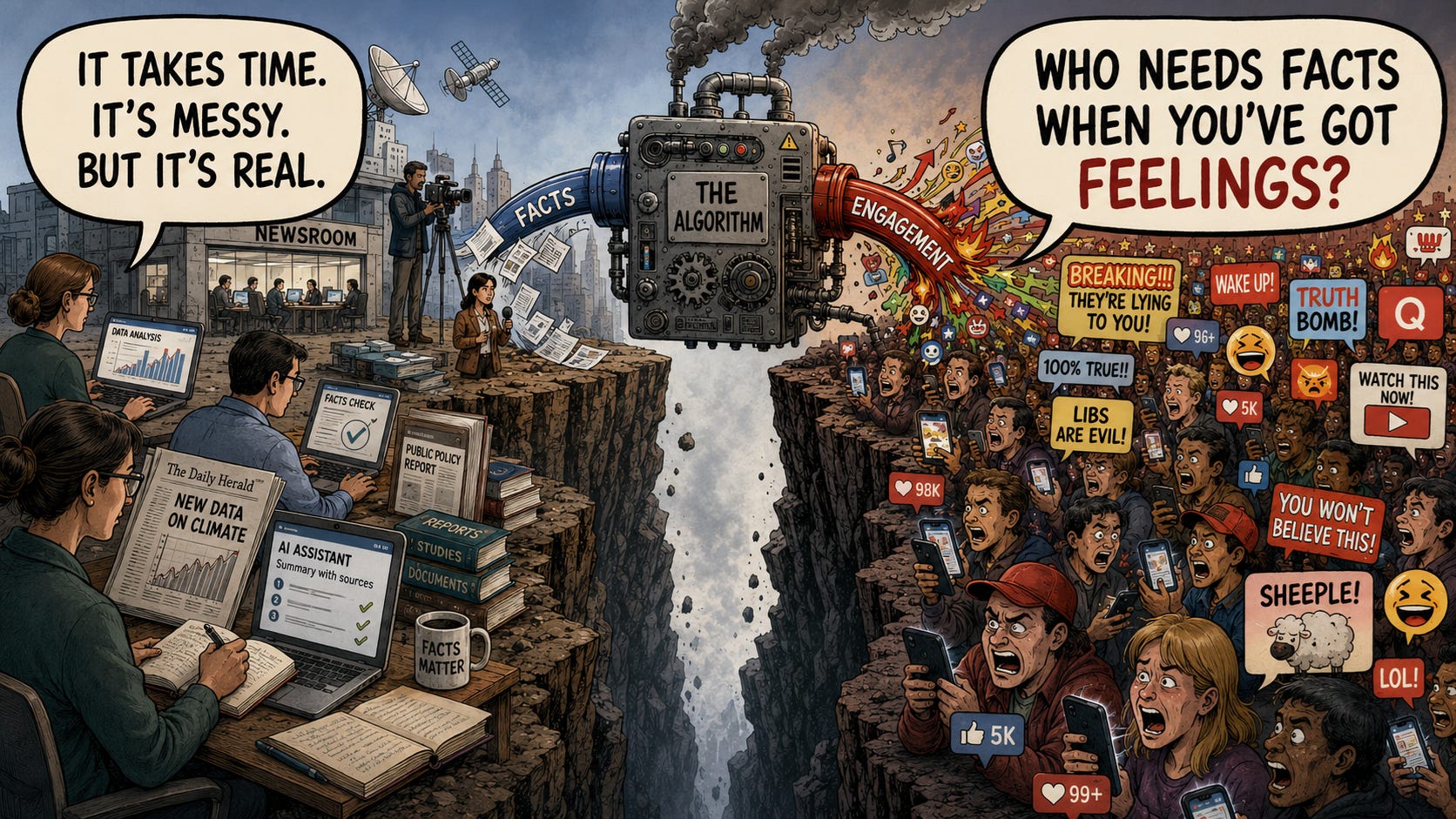
We argue, in light of grim new data from Reuters, that society is splitting into two distinct information worlds. One consists of people who still rely on journalism, research, and expert analysis to make informed decisions. The other is driven by algorithms, influencers, outrage, and entertainment, where truth competes with propaganda and misinformation. AI is not creating news but repackaging journalists’ work, often without directing readers to original reporting, threatening journalism’s financial survival. As fewer people seek factual news, democratic societies risk losing a shared understanding of reality, widening inequality between informed elites and an increasingly misled public.
Two Countries, One Disease
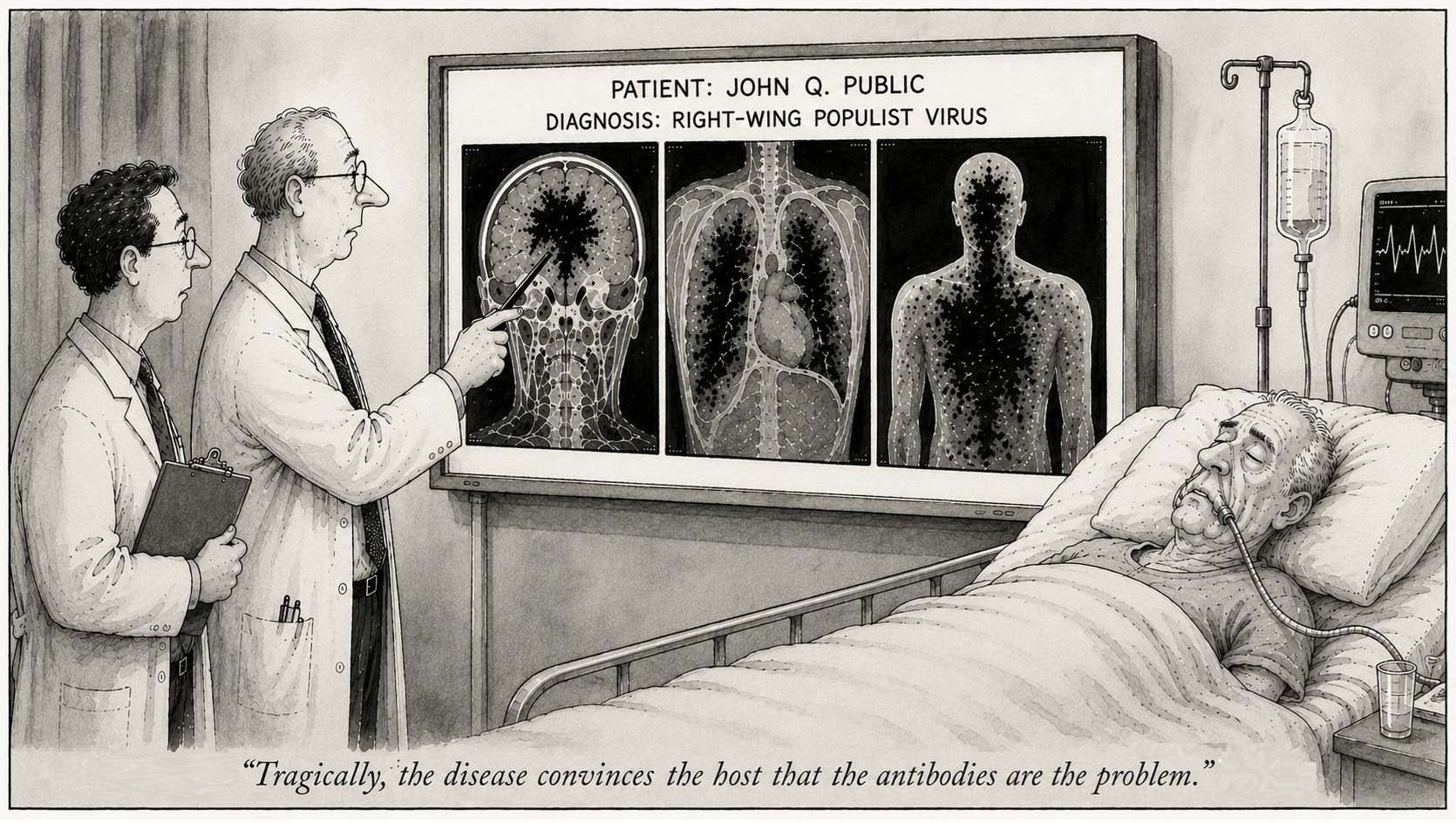
In this essay, we argued that the United States and Israel are suffering from the same societal illness: right-wing authoritarian populism that claims to speak for ordinary people while systematically undermining the institutions meant to protect them. Using two recent controversies as examples, we criticize Donald Trump’s appointment of a loyal political ally with no intelligence background to oversee America’s intelligence community and Netanyahu’s effort to install his longtime personal lawyer as Israel’s state comptroller. Both episodes reflect a broader pattern in which loyalty is valued above competence, independence, and public accountability. Upcoming elections in both countries will serve as a referendum on whether voters are willing to reject what he sees as a growing culture of populist contempt for democratic governance and the rule of law.
Spending Time With A Person You Love (or do you?)

On the Critical Conditions podcast, Dan Perry and Claire Berlinski discussed what happens when modern people are suddenly disconnected from the internet. The conversation was prompted by Berlinski’s unexpected four-day internet outage, which initially caused frustration but eventually became a form of liberation. She described rediscovering creative pursuits such as painting and sculpture and reconnecting with the kind of interior imaginative life that constant connectivity often crowds out. Perry and Berlinski explored how social media and digital platforms have transformed attention, politics, and public discourse, rewarding outrage, certainty, and emotional intensity while making people permanently interruptible. Can we still tolerate being alone with our own thoughts?
Every Criminal Loves His Gun
After Kremlin spokesman Dmitry Peskov claimed nuclear weapons are “the only thing that protects the world from a global war,” AQL examined the limits of nuclear deterrence. We argue that while nuclear arsenals may discourage direct conflict between major powers, they also embolden aggressive states by shielding them from meaningful retaliation, citing Russia’s invasion of Ukraine as the clearest example. A nuclear-armed Iran would be less likely to launch nuclear attacks than to use its arsenal as protection while expanding regional aggression through proxies terrorist armies of the conventional variety.
“Compute” Is a Jargonistic Scourge. Ban It!
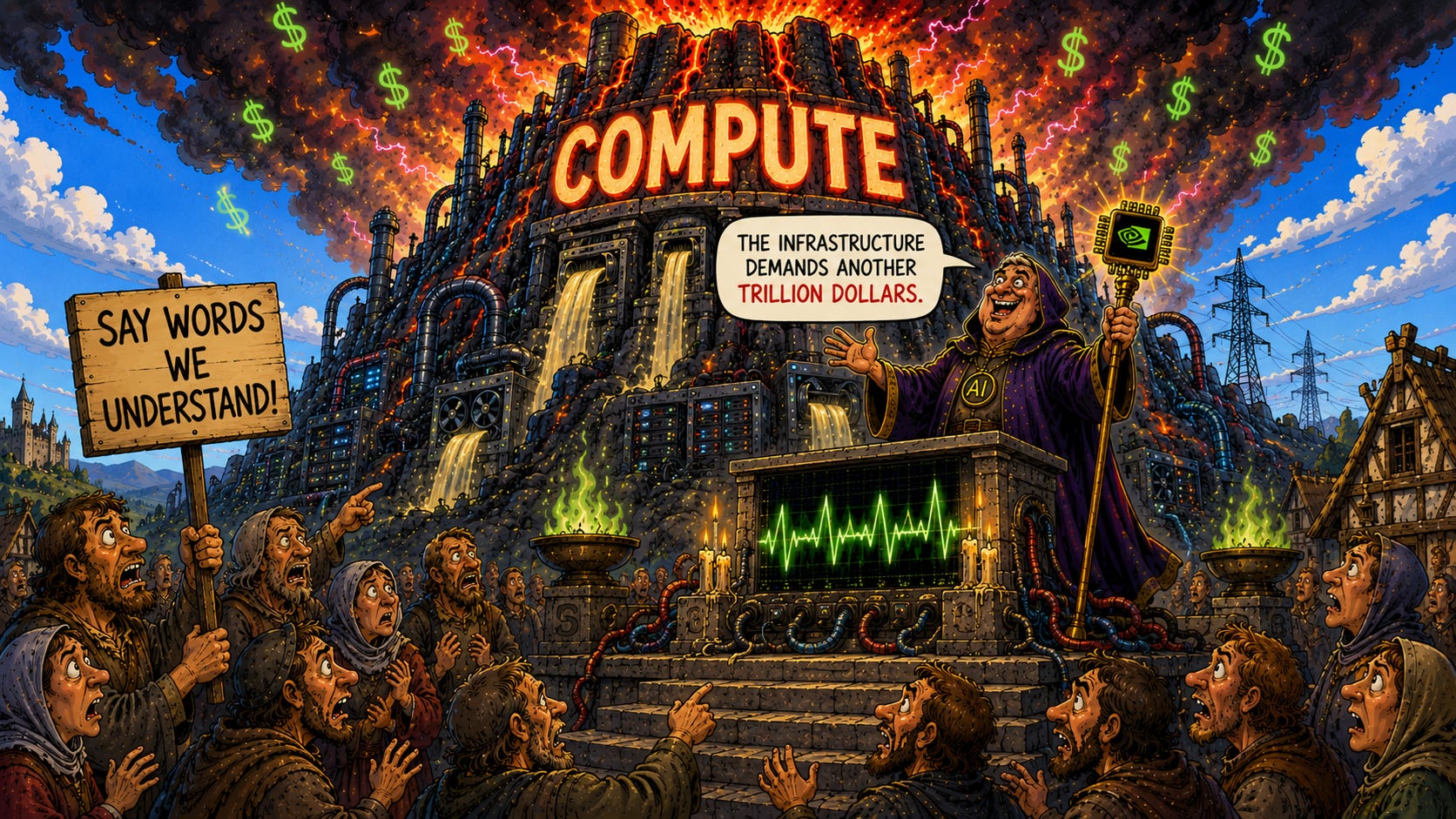
We fearlessly argued that the tech industry’s growing use of the word “compute” is an example of unnecessary jargon that obscures meaning rather than clarifying it — as “processing power” or “computing capacity” are clearer and more precise. We traced a broader pattern of technical jargon — such as “bandwidth,” “input,” and “leverage” — escaping specialist circles and entering everyday language. Drawing on George Orwell’s concerns about language and clarity, we argued that “compute” reflects Silicon Valley’s culture of abstraction, exclusivity, and technological determinism. Media should bin it, as was done with “LatinX.”
Kosovo Diary

Following last month’s trip to Berlin, Dan Perry went to Kosovo to speak at a conference on post-conflict transition, reconciliation, and justice. There, he reflects on one of the world’s most contested states nearly two decades after its declaration of independence. Marking Kosovo’s Liberation Day, he explores the unresolved questions of nationhood, sovereignty, and historical memory that continue to shape the Balkans. Through conversations with politicians, journalists, diplomats, and ordinary citizens, he examined lingering tensions over wartime accountability, relations with Serbia, and Kosovo’s aspirations for European Union membership.
Vienna Waits for You

From there, Perry traveled to Vienna and reflected on the city that had long served as a hub for his journalism in post-communist Eastern Europe and the Balkans. Perry describes Vienna as a “successful failed city” — wealthy, elegant, and highly livable, yet still living in the shadow of its vanished imperial past. He traces Vienna’s history as the capital of the Austro-Hungarian Empire, a cosmopolitan center of culture, intellectual life, and Jewish creativity before the catastrophes of the twentieth century shattered that world. Vienna remains a place that values patience, culture, and contemplation in a hurried, harried world.
ump and Netanyahu. I’ll admit that right off the bat — and yet this case is rather tempting.
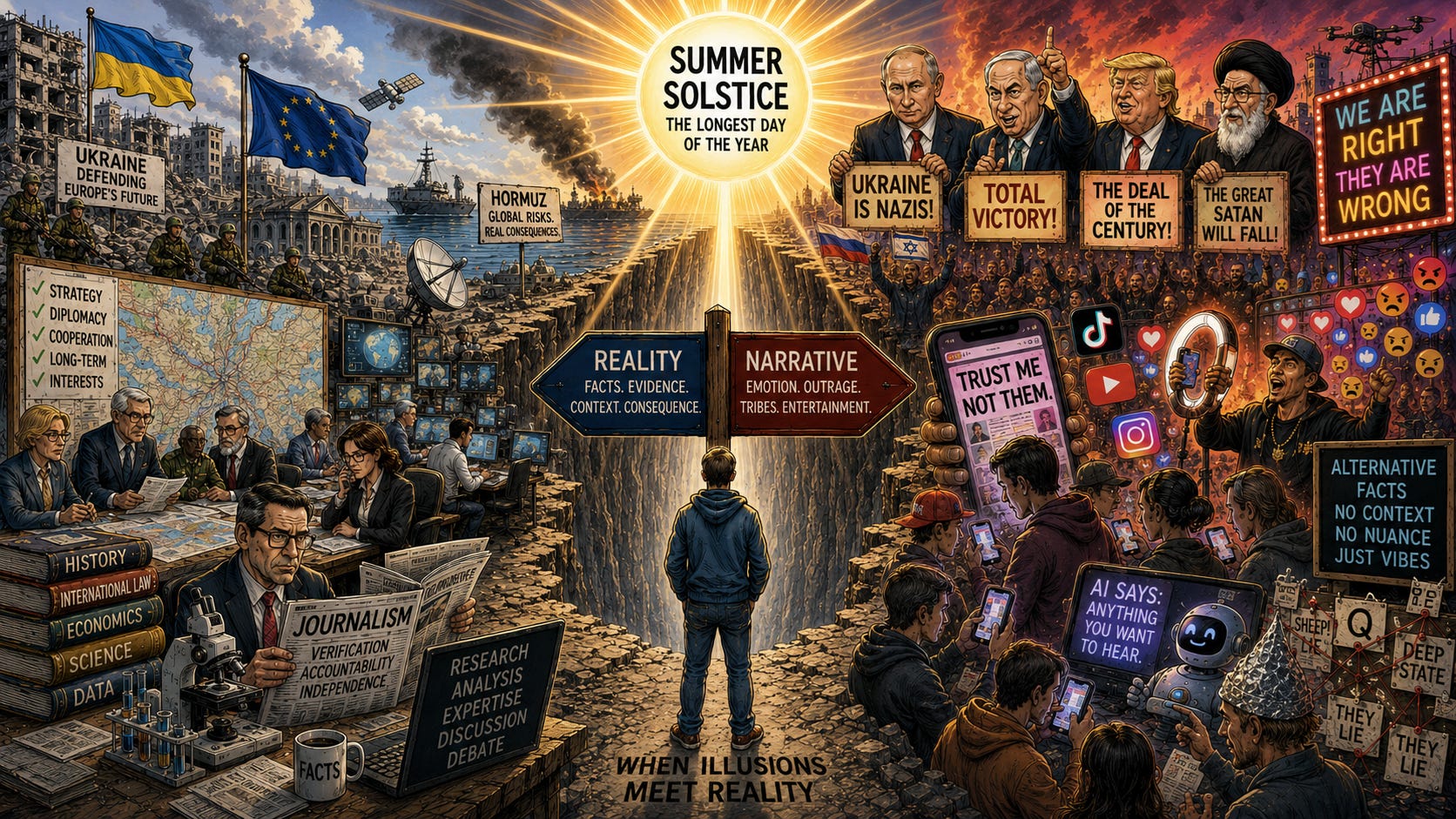
So many narratives! There is a great Dire Straits lyric that goes: “Two men say they’re Jesus — one of them must be wrong.” It is both a snarky subtlety of a kind that’s utterly missing in today’s culture — but also a prescient reflection of our current moment. Our trusty AI cartoonist takes a stab as describing it, guided by a level of effective promoting that only an hour’s practice can produce.